How to Start a Low FODMAP Diet Easily
If you've been dealing with bloating, abdominal pain, excess gas, diarrhea (diarrhoea), constipation, or some frustrating combination of all of the above, you have likely researched how to start low fodmap diet routines. It's recommended by gastroenterologists and dietitians worldwide, and it's among the most researched dietary approaches for managing Irritable Bowel Syndrome (IBS) — a condition that affects roughly 1 in 7 people worldwide.
While major public health authorities like the US National Institute of Diabetes and Digestive and Kidney Diseases (NIDDK), alongside the UK's Food Standards Agency (FSA) and National Health Service (NHS), provide broad dietary guidelines for general metabolic balance, targeted frameworks like the Low FODMAP diet are frequently utilized to support personal digestive wellness.
The problem? It can feel completely overwhelming when you're first getting started. Between the unfamiliar acronym, the long food lists, and the vague sense that you're about to give up everything you enjoy eating, it's easy to close the tab before you even begin.
Here's the good news: you don't need to memorize hundreds of foods overnight, and you don't need to follow this diet forever. Understanding a handful of key principles makes the whole process far less intimidating — and this guide walks through exactly what you need to know to get started.
What Does "FODMAP" Mean? (A Guide to Low FODMAP for Beginners)
FODMAP is an acronym for:
Fermentable
Oligosaccharides
Disaccharides
Monosaccharides
And
Polyols
These are all types of short-chain carbohydrates that are poorly absorbed in the small intestine. In people who are sensitive to them, these carbohydrates draw extra water into the gut and get rapidly fermented by gut bacteria — a combination that stretches the intestinal wall and can trigger symptoms like:
Bloating
Gas
Abdominal pain
Diarrhea
Constipation
General stomach discomfort
The diet was actually developed by researchers at Monash University in Australia, whose gastroenterology team first identified and named FODMAPs back in 2005. Since then, the approach has been studied extensively, and research consistently shows that between 50% and 80% of people with IBS experience meaningful digestive support on a low FODMAP diet, a notably high response rate for a dietary intervention.
Importantly, not everyone reacts to the same FODMAPs. Some people are sensitive to fructans (found in wheat and onions), others react more to polyols (found in certain fruits and artificial sweeteners), and many people are sensitive to a mix. That's exactly why the diet is designed as a temporary, structured discovery process — not a list of foods you avoid for the rest of your life.
The Three Phases of the Low FODMAP Diet
One of the most common misconceptions about this diet is that you have to avoid high-FODMAP foods forever. You don't — and you shouldn't. The diet is built around three distinct phases, and skipping the second and third phases is one of the most common reasons people end up frustrated with it.
Phase 1: The FODMAP Elimination Phase
For roughly 2–6 weeks, you reduce high-FODMAP foods to see whether your symptoms improve. This phase isn't meant to be a long-term way of eating — it is a personal discovery process, closer to an experiment than a lifestyle.
Phase 2: Reintroduction
Foods are gradually reintroduced one FODMAP category at a time — typically over a few days per category — to identify which specific ones actually trigger your symptoms and which ones you tolerate just fine. This is arguably the most important phase, since it's where you get your real answers, but it's also the phase people are most tempted to skip.
Phase 3: Personalization
Using what you learned in Phase 2, you build a long-term eating pattern that includes as many tolerated foods as possible, while limiting only the specific foods that consistently cause problems for you. The guiding principle throughout all three phases is always the least restrictive diet possible to support IBS naturally — restriction is a means to an end, not the goal itself.
Skipping straight to permanent restriction (and never reintroducing) is one of the biggest mistakes people make, since it can lead to unnecessary nutrient gaps and a much smaller, more boring diet than you actually need.
Low FODMAP Foods You Can Usually Enjoy
Plenty of nutritious, satisfying foods are naturally low in FODMAPs, which is worth remembering when the diet starts to feel restrictive.
Proteins
Chicken
Turkey
Beef
Fish
Eggs
Firm tofu
Vegetables
Carrots
Bell peppers (sweet peppers)
Cucumbers
Zucchini (courgette)
Spinach
Tomatoes
Green beans
Fruits
Strawberries
Blueberries
Oranges
Kiwi
Pineapple
Grapes
Grains
Rice
Quinoa
Oats
Corn
Potatoes
Notice how much variety is already on this list. A low FODMAP diet, done well, still leaves you with a genuinely wide range of proteins, vegetables, fruits, and grains to build meals around.
Common High-FODMAP Foods to Limit
Certain foods are frequent symptom triggers across a large share of people with IBS, which is why they tend to be restricted first during elimination:
Onions
Garlic
Wheat products (bread, pasta, many cereals)
Apples
Pears
Watermelon
Milk (for some people, due to lactose)
Honey
Beans and lentils, particularly in larger portions
Portion size matters more than people expect here. Some foods — including several legumes and even certain fruits — are perfectly fine in a low FODMAP diet at a small serving size, but become high-FODMAP once you eat a larger portion. This is part of why FODMAP-tracking apps use a "traffic light" system rather than simple yes/no labels: green for freely enjoy, yellow for moderate portions, red for avoid or minimize. It's a more useful way to think about these foods than a strict ban list.
Beginner Mistakes to Avoid
Trying to Memorize Every Food
You don't need to hold hundreds of foods in your head to succeed at this. Instead of trying to become a walking FODMAP encyclopedia, focus on building a small rotation of meals you genuinely enjoy and know are safe. A FODMAP app (Monash University publishes the original one, built directly from their research database) can handle the lookup work for you, so you're not relying on memory during a stressful grocery trip.
Staying in Elimination Too Long
The elimination phase is meant to last weeks, not months or years. Staying in strict elimination indefinitely can lead to a narrower, less balanced diet than necessary, and it means you never actually learn what your personal triggers are, which defeats the point of doing this in the first place.
Ignoring Portion Sizes
As mentioned above, many foods are low FODMAP in small servings and high FODMAP in larger ones. Treating every food as simply "allowed" or "not allowed," without paying attention to amount, is one of the fastest ways to get inconsistent, confusing results.
Forgetting About Stress and Lifestyle
Diet isn't the only lever here. Stress, poor sleep, and general lifestyle factors are well-documented contributors to digestive symptoms, particularly in IBS, where the gut-brain connection plays a significant role. If you're doing everything right with food and still struggling, it's worth looking at sleep quality, stress levels, and movement as part of the bigger picture—not as afterthoughts.
Going It Completely Alone
This diet is genuinely easier — and safer, from a nutrition standpoint — with support from a registered dietitian, particularly one who specializes in digestive health. They can help ensure you're not unnecessarily cutting out entire food groups while maintaining your digestive balance, and can streamline the reintroduction phase considerably.
A Simple Low FODMAP Day of Eating
Breakfast: Greek yogurt (yoghurt) with strawberries and chia seeds
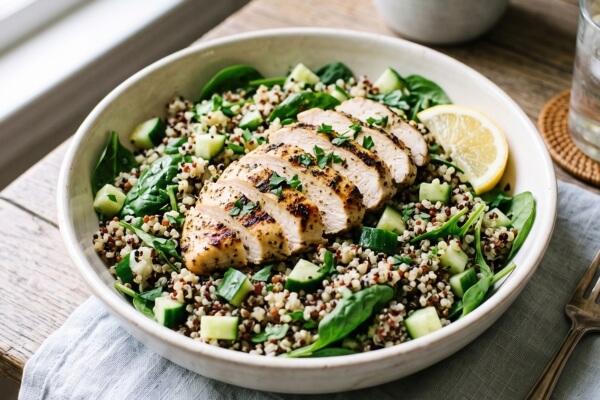
Lunch: Grilled chicken quinoa salad with cucumber and spinach
Snack: Rice cakes with peanut butter
Dinner: Baked salmon with roasted potatoes and green beans
Notice this isn't a special "diet food" menu — it's just a normal, satisfying day of eating that happens to avoid the most common trigger ingredients. That's the goal throughout: this should look and feel like real food, not a restrictive regimen.
The Bottom Line
Starting a Low FODMAP Diet doesn't have to be overwhelming. Think of it as a structured, time-limited experiment designed to help you identify your personal triggers — not as a list of foods you'll never eat again. The research supporting this approach is substantial: it's one of the most well-studied dietary interventions for IBS, and most people who follow it properly through all three phases see real improvement in their symptoms.
By understanding the three phases, focusing on a small set of simple meals you enjoy, and reintroducing foods systematically rather than skipping that step, you can make the process significantly easier — and build a long-term eating pattern that supports both digestive comfort and nutritional balance.
Ready to take the guesswork out of your meals? Get a complete 14-day meal plan and delicious recipes designed specifically for sensitive stomachs: