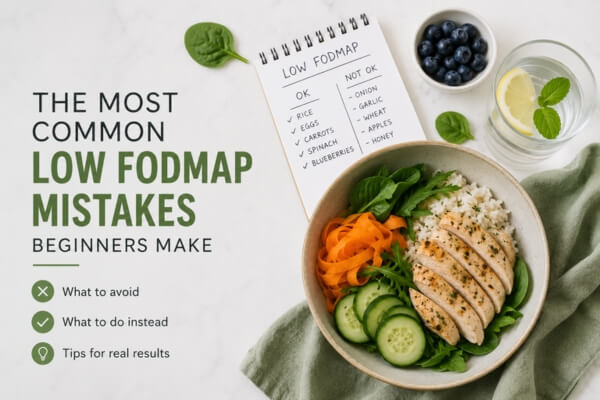
10 Low FODMAP Diet Mistakes Beginners Make
Starting a low FODMAP diet can feel a bit like learning a new language overnight. Suddenly ordinary foods get sorted into unfamiliar categories, serving sizes actually matter, food labels turn into a puzzle, and ingredients like garlic or chicory root seem to be hiding in everything.
The diet genuinely can help some people manage IBS symptoms—including abdominal pain, bloating, gas diarrhea (diarrhoea), constipation, or some combination of all of the above. FODMAPs are fermentable carbohydrates that can pull extra water into the intestine and get fermented by gut bacteria, which contributes to distension and symptoms in people who are sensitive to them. That said, it's worth knowing that the American College of Gastroenterology (ACG), alongside the British Dietetic Association (BDA), only recommends a limited trial of the diet for IBS, and is upfront that the supporting evidence is conditional and low quality. This isn't a guaranteed fix for everyone with digestive symptoms.
More importantly — and this is the part beginners miss most often — the low FODMAP diet was never meant to be a permanent elimination diet. It's a structured, three-stage process:
A short restriction phase
Systematic FODMAP reintroduction
A personalized long-term diet
The American Gastroenterological Association (AGA), aligning with the British Society of Gastroenterology (BSG), is specific about the timeline here too: the initial restriction phase shouldn't run longer than about four to six weeks before you move into reintroduction and personalization.
A lot of beginners never get that full picture. As a result, they end up restricting more than they need to, missing sneaky sources of FODMAPs, or deciding the whole approach "didn't work" before they ever actually tested it properly. Here are the most common low FODMAP diet mistakes that come up again and again—and what to do instead.
Mistake 1: Starting the Diet Without Confirming What's Actually Causing the Symptoms
Bloating, diarrhea, constipation, and abdominal pain aren't unique to IBS. Celiac (coeliac) disease, inflammatory bowel disease, infections, medication side effects, lactose intolerance, and plenty of other conditions can look nearly identical on the surface.
A low FODMAP diet can shift your symptoms around without ever telling you what's actually wrong — and it can genuinely delay proper testing, especially if you cut out wheat before ever being screened for celiac disease.
Current ACG guidance actually leans toward a positive diagnostic approach to IBS, rather than managing it as something you only arrive at by ruling everything else out. For people with suspected IBS and diarrhea specifically, the guideline recommends celiac blood testing and suggests checking fecal (faecal) calprotectin to help rule out inflammatory bowel disease first.
A better approach: Talk to a healthcare professional about recurring symptoms before exploring a gut-soothing elimination protocol. This matters even more if your symptoms are new, severe, getting worse, or come with bleeding, unexplained weight loss, anemia, fever, persistent vomiting, nighttime symptoms, or a family history of serious GI disease.
Mistake 2: Treating the Restriction Phase as a Permanent Diet
Some people feel better once they cut out high-FODMAP foods, and then get genuinely afraid to bring anything back.
They end up stuck on the strictest version of the diet for months, sometimes years — avoiding wheat, legumes, a long list of fruits, dairy, onion, garlic, and a stack of vegetables, even though they might tolerate a good number of these foods just fine.
That's not how the diet was designed to work. Step 1 exists to create a temporary, controlled baseline so you can later test your own individual FODMAP tolerances against it. Step 3's whole point is restoring as much variety as possible, restricting only the specific foods and portions that reliably cause problems for you personally.
Staying restrictive longer than necessary tends to shrink your food variety, make social eating genuinely stressful, and cut your intake of useful prebiotic carbohydrates. Monash specifically notes that fructans and GOS act as prebiotic fiber (fibre) and should go back into your diet once you know you tolerate them.
A better approach: If symptoms improve during that initial two-to-six-week window, start structured FODMAP reintroduction. Don't keep eliminating foods indefinitely just because things feel stable right now.
Mistake 3: Assuming "Low FODMAP" Means "Gluten-Free"
Wheat, barley, and rye all contain fructans, which is why some wheat-based foods get limited during the initial phase. That leads a lot of people to assume the low FODMAP diet is basically a gluten-free diet with extra steps.
It isn't.
Gluten is a protein. FODMAPs are fermentable carbohydrates — a completely different thing. Some gluten-containing foods, including certain servings of spelt bread and oats, can actually be low in FODMAPs. Meanwhile, a product proudly labeled gluten-free can still be loaded with high-FODMAP ingredients like inulin, chickpea flour, soy flour, apple concentrate, or certain sweeteners.
If you have celiac disease, avoiding gluten is medically necessary, full stop. That's a genuinely different situation from temporarily adjusting your wheat intake to manage fructans.
A better approach: Choose foods based on their actual tested FODMAP content and serving size — not on whether the front of the package happens to say "gluten-free."
Mistake 4: Cutting Out All Dairy
The "D" in FODMAP stands for disaccharides, which includes lactose. It does not mean every single dairy product is automatically high-FODMAP.
Hard cheeses, butter, and several other dairy foods naturally contain very little lactose. Lactose-free milk and yogurt work well for a lot of people too. On the flip side, a dairy-free product isn't automatically low-FODMAP either — it might be built around inulin, whole-soybean milk, or a high-FODMAP fruit concentrate instead.
Cutting out all dairy without replacing what it was providing can quietly leave you short on calcium, protein, vitamin B12, and other nutrients you actually need.
A better approach: Learn the difference between "lactose-free" and "dairy-free" — they're not the same thing. Use tested serving information, and reach for lactose-free dairy or a nutritionally solid alternative when you need one.
Mistake 5: Ignoring Serving Size Entirely
Foods aren't simply "high" or "low" FODMAP as a fixed label. A lot of them change category depending on how much you eat.
A food can rate low FODMAP at one serving size and jump to moderate or high once you double or triple the portion. That's exactly why Monash's traffic-light system gives separate ratings for different serving sizes rather than one blanket verdict. This trips people up constantly with foods like:
Avocado
Sweet potato
Certain fruits
Almonds and other nuts
Canned legumes
Oats
Some vegetables
One beginner sees a food marked green and assumes there's no limit at all. Another sees a red rating tied to a large portion and avoids the food entirely, not realizing a smaller amount would have been completely fine.
A better approach: Actually check the specific amount attached to the rating, not just the color. Measure unfamiliar portions during the initial phase using a structured low-FODMAP grocery guide until you get a real feel for what they look like on a plate.
Mistake 6: Getting Overly Anxious About "FODMAP Stacking"
FODMAP stacking refers to combining several individually low-FODMAP foods in a way that adds up to a meaningful fermentable-carb load once they're all eaten together. It's a genuinely real thing to be aware of — but some beginners get so worried about it that their meals shrink down to plain rice, plain meat, and a single vegetable.
Monash's own advice is to focus on stacking mainly when the diet has already improved most of your symptoms, but a few are still hanging around despite you following the correct low-FODMAP servings. You don't need to assume every combination of green-rated foods is secretly a problem waiting to happen.
A better approach: Learn your appropriate individual servings first and build genuinely balanced meals around them. Only start investigating stacking specifically when there's a consistent pattern that portion size, hidden ingredients, constipation, or stress can't already explain.
Mistake 7: Missing Hidden High-FODMAP Ingredients
A meal can look completely low-FODMAP right up until you factor in the sauce, seasoning, supplement, or packaged ingredient sitting quietly alongside it.
Common hiding spots include:
Onion or garlic powder
Onion or garlic extract
Inulin
Chicory root or chicory fiber
Fructo-oligosaccharides (FOS)
Galacto-oligosaccharides (GOS)
Fruit juice concentrates
High-fructose sweeteners
Honey or agave
Polyol sweeteners in sugar-free products
Wheat or legume flours in snack foods
Prebiotic bars, "gut health" cereals, protein powders, flavored yogurts, stocks, marinades, packaged meat products, and plant-based foods are all frequent culprits for smuggling in inulin, chicory fiber, garlic, or onion.
Worth knowing, too: label reading has real limits. An ingredient list can't tell you the exact FODMAP quantity, and manufacturing methods can shift the final content in ways you'd never guess from the package.
A better approach: Read labels during the initial phase, but don't try to hunt down every single molecule — that's a recipe for burnout. Lean on simple, minimally processed products, or independently certified low-FODMAP products when you can find them.
Mistake 8: Cooking With Onion or Garlic and Fishing It Out Later
A tip that circulates a lot: toss whole onion or garlic into a soup, curry, or sauce for flavor, then remove the pieces before eating.
Unfortunately, that trick doesn't reliably make the dish low-FODMAP.
The fructans in onion and garlic are water-soluble. Once they're cooked in soup, stock, sauce, or any water-based dish, a good portion of those fructans leach into the liquid itself and stay there — pulling the pieces back out afterward doesn't undo that.
Oil behaves differently. Fructans don't dissolve into oil the same way, which is why properly made garlic-infused oil can genuinely deliver flavor without carrying the FODMAP load.
A better approach: Reach for suitable garlic-infused oil, the green tops of scallions (spring onions), chives, a small amount of asafoetida, ginger, citrus zest, herbs, or spices, or use an onion- and garlic-free stock. One safety note: don't leave fresh garlic pieces sitting in homemade oil for storage — that combination carries a real food-safety risk (botulism, specifically), regardless of the FODMAP question.
Mistake 9: Reintroducing Several Foods at Once
After finally feeling better, it's tempting to celebrate with pizza, ice cream, garlic bread, and dessert, all in one sitting. If symptoms come roaring back afterward, good luck figuring out whether the culprit was lactose, wheat fructans, garlic fructans, excess fructose, the sheer size of the meal, the fat content, or some combination of all of it.
Step 2 exists specifically to test one FODMAP category at a time while keeping the rest of your diet relatively stable. Monash recommends challenging one FODMAP group at a time, typically over a structured three-day window, while tracking your symptom response carefully.
Different fructan sources can also require separate testing entirely — someone might react to garlic but tolerate onion just fine, or vice versa, or react differently again to wheat.
A better approach: Pick one appropriate challenge food, start when your symptoms are reasonably calm, and change only that one tested portion. Let symptoms fully settle before you move on to the next challenge.
Mistake 10: Expecting the Diet to Eliminate Every Symptom
The diet can genuinely help manage IBS symptoms for a lot of people—but it doesn't work for everyone, and it rarely erases symptoms completely.
Plenty of other things influence how your gut behaves day to day, including:
Constipation
Stress and anxiety
Menstrual-cycle changes
Gastroenteritis
Medications
Intense exercise
Large meals
Eating quickly
Poor sleep
Other underlying GI conditions
Monash is direct about this: factors completely outside of diet genuinely affect IBS symptoms, and persistent symptoms don't automatically mean you've eaten a hidden FODMAP somewhere. For constipation-predominant IBS specifically, cutting FODMAPs without protecting enough fiber (fibre) and fluid intake can leave the constipation unresolved — or actually make it worse. Monash notes the diet alone is often not enough on its own for IBS-C.
A better approach: Decide ahead of time what "meaningful improvement" would actually look like for you. Track abdominal pain, bloating, stool frequency, stool consistency, urgency, and overall quality of life — rather than holding out for a perfectly symptom-free gut, which isn't a realistic bar for any digestive intervention.
If a properly followed four-to-six-week trial hasn't produced meaningful improvement, restricting even further usually isn't the right next move. The AGA's own advice is to abandon a dietary intervention that isn't working and move on to another management option instead.
A Better Plan: Navigating Low FODMAP for Beginners
Here's a more practical way to structure a low FODMAP trial from the start.
Step 1: Establish a baseline
Before changing anything, track your symptoms and bowel habits for several days. You need something honest to compare against later.
Step 2: Simplify, don't starve
Build meals around low-FODMAP servings of:
Rice, potatoes, oats, quinoa, or suitable bread
Eggs, fish, poultry, firm tofu, or another tolerated protein
Appropriate vegetables and fruits
Lactose-free dairy or a suitable alternative
Nuts, seeds, and oils in moderate portions
The diet should still deliver plenty of food, fiber (fibre), protein, and real variety — restriction isn't the same thing as deprivation.
Step 3: Follow the trial consistently
A diet followed strictly for two days and loosely for the next five is nearly impossible to properly evaluate. That said, perfection isn't the goal either — aim for a clear, manageable trial rather than becoming afraid of every single ingredient on your plate.
Step 4: Review your response after two to six weeks
If symptoms meaningfully improve, move into reintroduction. If nothing's changed and you are still bloated on low-FODMAP despite genuinely following the diet correctly, it's time to revisit the diagnosis, constipation management, portion sizes, eating pattern, stress levels, and other treatment options.
Step 5: Personalize
Bring back tolerated FODMAPs, and restrict only the categories and quantities that repeatedly cause real symptoms. Tolerance can genuinely shift over time, so a food you struggled with early on is sometimes worth retesting later.
Who Should Be Especially Careful With a Restrictive Diet Like This?
The AGA specifically flags several groups who tend to be poor candidates for restrictive IBS diets: people already eating very few of the suspected trigger foods to begin with, anyone at risk of malnutrition, people dealing with food insecurity, and those with an eating disorder or an uncontrolled psychiatric condition.
This isn't a minor footnote, either. At the ACG's 2025 Annual Scientific Meeting, gastroenterologists specifically debated the intersection of restrictive IBS diets and eating disorders, and reached general agreement that clinicians should screen for eating disorder risk before recommending a low FODMAP diet — or any other restrictive diet — for IBS symptoms. Current AGA guidance goes as far as calling eating-disorder screening "critical" before starting this kind of intervention, precisely because disordered eating is common and frequently overlooked in people presenting with digestive symptoms.
Children, pregnant people, older adults, anyone underweight, and people already managing multiple medical diets at once may also need closer professional oversight to keep their nutrition adequate throughout the process.
Whenever it's an option, the low FODMAP process goes much more smoothly with a registered dietitian who has specific training in IBS and FODMAP management guiding you through restriction, reintroduction, and personalization — Monash itself recommends exactly this level of professional support.
The Bottom Line
The single biggest beginner mistake is treating the low FODMAP diet like a permanent list of foods that are safe or forbidden forever.
It's better understood as a short-term experiment: reduce FODMAP intake, watch whether symptoms meaningfully improve, test individual FODMAP groups one at a time, bring back what you tolerate, and land on the least restrictive diet that still gives you acceptable symptom control.
Serving size matters more than color-coding. Dairy isn't automatically off the table. Gluten-free doesn't mean low-FODMAP. Onion doesn't disappear from soup just because you fish the pieces back out. And reacting to one food in a category doesn't mean every food in that category has to go.
The goal was never to become perfect at avoiding FODMAPs. It's to actually learn which foods, portions, and combinations your own digestive system can genuinely handle to support daily digestive wellness.
This article is intended for general information and isn't a substitute for advice from a doctor or registered dietitian, especially before starting a restrictive diet.