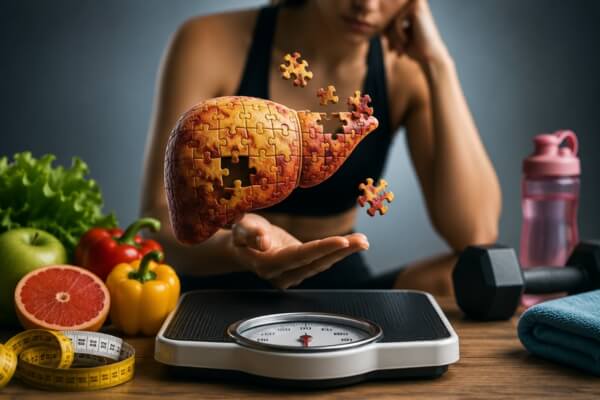
Why Weight Loss Doesn't Always Fix Fatty Liver
You did the work. The scale moved. Then the scan came back and the fat is still there.
It's a deflating moment, and the conclusion people usually draw from it — that the effort was pointless — is almost always wrong. But so is the assumption underneath the frustration: that body weight and liver fat move together in a straight line. They don't.
When it comes to MASLD weight loss, the reality is that metabolic dysfunction-associated steatotic liver disease responds best to a cluster of things: insulin resistance, where your body stores fat, diabetes control, genetics, alcohol, certain medications, sleep apnea, muscle mass, and how far the disease had progressed before you started. Weight is one input among many.
Below are eleven reasons the scan may not have changed — and a section on what's changed in treatment recently, because that part has moved fast and most articles on this topic haven't caught up.
What's Changed in MASLD Management Protocols (2024–2025)
Until March 2024, the only standard management approach for MASH — the inflammatory form of the disease — was lifestyle change. That's no longer the case. Two medications now carry regulatory approval for MASH with moderate-to-advanced fibrosis (stages F2–F3).
Resmetirom (Rezdiffra) received FDA accelerated approval in March 2024, conditional EU approval in August 2025, and UK MHRA authorization in June 2026. In the trial supporting approval, MASH resolved without fibrosis worsening in roughly 26–30% of participants depending on dose, versus about 10% on placebo.
Semaglutide (Wegovy) received FDA accelerated approval in August 2025, becoming the first GLP-1 with a liver indication. In the phase 3 ESSENCE trial, about 63% achieved MASH resolution without worsening fibrosis versus 34% on placebo.
Some important limits on both. These are accelerated approvals, meaning long-term outcome data is still being gathered. Neither is approved for cirrhosis. Both are labeled for use alongside diet and exercise, not instead of them. And both target people with significant fibrosis — not everyone with fat visible on an ultrasound.
None of this is a recommendation. Eligibility depends on your fibrosis stage, other conditions, and other medications, and it's a decision for a hepatologist or your primary care physician (GP). The reason it's here is narrower: if you've lost weight and your liver hasn't responded, "try harder" is no longer the only thing available, and that's worth knowing before you read the rest.
11 Reasons Your Fatty Liver Scan Hasn't Changed
1. The weight loss may not have crossed the threshold yet
Different amounts of weight loss do different things, and the major guidelines don't fully agree with each other — which is worth knowing, because you may have been given one number as though it were settled.
AASLD notes that around 3–5% loss can improve liver fat. European guidance (aligning with broad US AASLD principles) is stricter: EASL and ESPEN point to 7–10% for improving steatosis and liver biochemistry, and more than 10% to reverse fibrosis.
For someone starting at 220 pounds (100 kg), 5% is about 11 pounds (5 kg), 7% is about 15 pounds (6.8 kg), and 10% is about 22 pounds (10 kg).
So losing six or seven pounds may genuinely improve blood pressure, glucose control, and how you feel — while sitting below the range where anyone would expect a visible liver fat reduction.
Modest progress isn't failure. The more useful question is whether the loss is continuing, and whether waist size, triglycerides, glucose, liver enzymes, or liver stiffness are moving.
2. The scale can't tell you what you lost
In the first weeks of a lower-carb or lower-calorie diet, a chunk of the change is water and stored glycogen. With very restrictive dieting, low protein, illness, or no resistance training, some can be muscle.
That matters more here than in ordinary weight management, because MASLD is bound up with insulin resistance and with how well fat tissue and muscle absorb excess energy. AASLD notes that lean people with fatty liver often have more visceral fat and less muscle than healthy people of the same weight.
You can get lighter without shifting much of the fat actually driving the problem.
What protects against this is unglamorous: enough protein, resistance training a couple of times a week, aerobic activity, gradual rather than punishing calorie reduction, and adequate sleep. Exercise reduces liver fat and improves metabolic health even when the scale barely moves — which is why both AASLD and European guidance treat it as part of treatment rather than an optional extra.
3. Visceral fat may still be high
Two people with the same BMI can carry fat in completely different places. Subcutaneous fat sits under the skin; visceral fat packs in around the organs, and it's the one more tightly linked to insulin resistance and to fatty acids moving toward the liver.
You can lose noticeably from your face, arms, and legs while your waist stays much the same. It's also why fatty liver appears in people who aren't overweight — leanMASLDis associated with increased visceral fat, insulin resistance, and reduced muscle mass compared with healthy lean individuals.
Waist circumference and how clothes fit won't diagnose anything, but they can reveal changes the scale hides.
4. Insulin Resistance: The Hidden Liver Mechanics Still Running the Show
This is the one people most often miss. Fatty liver isn't simply fat stored because you weighed too much. In most cases, it's the liver's share of a wider metabolic problem.
When tissues stop responding properly to insulin—a metabolic disruption similar to how hidden sugars impact digestion—more fatty acids get released from fat stores, blood glucose stays elevated, and the liver keeps making and storing fat. Type 2 diabetes is among the strongest predictors of progression to significant fibrosis.
So you can lose weight and still carry prediabetes or diabetes, high triglycerides, low HDL, high blood pressure, central abdominal fat, and persistent insulin resistance. The liver tends to improve slowly until those do.
Worth asking whether your monitoring includes fasting glucose, A1c, triglycerides, blood pressure, waist circumference, and a fibrosis risk assessment — not just weight.
5. You may have lost weight without improving the diet
A calorie deficit produces weight loss regardless of what the calories were made of. It's entirely possible to get lighter on smaller portions of sugary drinks, refined bread, processed meat, and highly processed "diet" products, with barely any fiber (fibre) involved.
AASLD links excess saturated fat, refined carbohydrates, and sugar-sweetened beverages with fatty liver. European guidelines specifically recommend limiting ultra-processed foods high in sugar and saturated fat, and avoiding sugary drinks.
The shift worth making is toward gentle, easy-to-digest foods like vegetables, whole fruit rather than juice, beans and lentils, oats (porridge) and barley, fish and other decent protein sources, and unsaturated fats in sensible amounts. A Mediterranean-style pattern is the usual recommendation, and it adapts to whatever cuisine you actually cook.
One addition that surprises people: the 2024 European guidelines explicitly encourage coffee, which is associated with less fibrosis progression in chronic liver disease. Not a medical treatment — but a rare case of a guideline telling you to keep a habit rather than drop one.
6. Alcohol may still be part of it — and there's now a name for that
"Metabolic" in the disease name doesn't make alcohol irrelevant. The 2023 nomenclature change created a middle category precisely for this overlap.
MetALD describes people who meet the criteria for MASLD and drink above the MASLD threshold: 140–350 grams of alcohol per week for women, 210–420 for men. Above that range, it's classified as alcohol-related liver disease.
If your intake sits in that band, the liver is being worked on from two directions, and weight loss alone was never going to resolve it.
Even below those thresholds, a 2024 study using elastography data from Spain and the US found low-to-moderate drinking was independently associated with significant fibrosis, and that alcohol and cardiometabolic risk factors interacted in a more-than-additive way. The more metabolic risk factors you carry, the less alcohol it takes to matter.
People also routinely underestimate intake, usually for structural reasons: home wine pours run larger than a standard serving, cocktails often contain two or three, and weekend drinking gets mentally excluded from the "average."
This is a conversation worth having honestly with a clinician. People with inflammation, fibrosis, or cirrhosis are often advised to stop entirely.
7. Genetics affects how much your liver responds
Variants in genes such as PNPLA3 and TM6SF2 change how the liver handles fat and influence the risk of steatohepatitis and fibrosis. Some people develop serious liver disease at a low body weight; others with obesity never develop advanced damage.
This isn't fatalism. It means two people making identical changes can get different results, and that comparing your progress to someone else's isn't informative. Routine genetic testing isn't recommended, because results usually don't change management. Family history still matters, particularly if a close relative has cirrhosis or advanced fatty liver disease.
8. The liver may simply need more time
Steatosis, inflammation, and fibrosis are three different things, and they don't improve on the same schedule.
Liver fat often falls relatively early. Inflammation and scarring typically require a larger, sustained metabolic improvement, and advanced fibrosis may improve slowly or incompletely. A scan repeated soon after weight loss may also just be too early to show what happened.
A realistic recovery timeline is measured in months and years. Maintenance, activity, and diabetes control matter more than the intensity of any short diet.
9. The weight may have come back between measurements
The lowest number you ever saw isn't the number your liver experienced.
Someone loses 15 pounds (approx. 7 kg), regains eight (3.6 kg), and reasonably says "I lost weight." From the liver's point of view, the sustained reduction was seven (3.1 kg).
AASLD is candid that maintaining clinically meaningful weight loss is difficult: relatively few people achieve substantial loss through lifestyle change alone, and many regain part of it. That isn't a character flaw. Appetite regulation, medications, stress, sleep, food access, work schedules, and metabolic adaptation all push the same way.
Trends beat single data points. A pattern you can hold beats a severe diet followed by regain.
10. Something else may be causing the liver fat
Not every fatty liver is metabolic. Other contributors include significant alcohol use, certain medications, hepatitis C, celiac disease, severe malnutrition, lipodystrophy, and rarer disorders of fat metabolism.
Medications associated with steatosis or steatohepatitis in some patients include corticosteroids, tamoxifen, amiodarone, and methotrexate. That's worth raising with whoever prescribed them — and not worth acting on alone. Never stop a prescribed medication without medical supervision.
AASLD recommends reviewing medications, alcohol, metabolic conditions, and family history when the picture is unusual or the liver isn't responding as expected.
11. The follow-up test may not have measured what you think
Not all liver tests measure the same thing.
A standard abdominal ultrasound picks up moderate or severe steatosis but is unreliable for mild fat, and can't tell you whether there's inflammation or scarring. Normal ALT and AST don't confirm anything has resolved.
Depending on the situation, clinicians use blood-based fibrosis scores such as FIB-4, transient elastography (FibroScan), controlled attenuation parameter, MRI-based fat measurement, and occasionally biopsy.
This matters more than it used to. AASLD's November 2025 update on semaglutide selects treatment candidates using non-invasive tests rather than routine biopsy. The question your test answers has shifted: not just "is there fat?" but "how much scarring, and does that qualify you for treatment?"
Questions worth bringing to your next appointment
If weight loss hasn't reduced your liver fat, these are reasonable things to raise:
How much weight did I lose and keep off, and where does that sit against the guideline thresholds?
What are my waist circumference and activity levels doing?
Can we check glucose, A1c, triglycerides, and blood pressure?
Should we review my alcohol intake and current medications?
Can we calculate or repeat a fibrosis-risk score?
Is elastography or another non-invasive test appropriate here?
Should another cause of liver disease be ruled out?
If I have F2–F3 fibrosis, am I a candidate for any of the newly approved treatments?
If you have overweight or obesity, further gradual loss is usually still worthwhile. If you're lean, aggressive weight loss may be the wrong target entirely, and diet quality, exercise, muscle preservation, metabolic control, and investigating other causes matter more.
Don't try to force it
Crash diets, extended fasting, detox products, and severe restriction aren't safer because the goal is your liver. The US National Institute of Diabetes and Digestive and Kidney Diseases (NIDDK), aligning with guidance from the UK's National Health Service (NHS), specifically warns that rapid crash dieting and malnutrition can stress metabolic function and worsen liver health. Supplements sold as liver cleanses are a recognized cause of drug-induced liver injury and can interact with prescriptions.
The liver doesn't need a cleanse. It needs the conditions driving the disease to improve, and to stay improved.
The bottom line
Weight loss genuinely does reduce liver fat, especially when paired with consistent liver support protocols. It just isn't instant, isn't universal, and isn't the only lever anymore.
Your liver may still be fatty because the loss was modest, or came partly from water and muscle, or because visceral fat and insulin resistance persist, or because diabetes and triglycerides aren't controlled, or because of diet quality or alcohol, or genetics, or because fibrosis needs longer, or because the weight came back, or because something else is causing it, or because the test didn't capture the full picture.
The more useful question isn't why is my liver still fatty?
It's: which drivers are still active, how advanced is the disease, and what are my options now?
That question gets you a plan.
References
Rinella ME, et al. A multisociety Delphi consensus statement on new fatty liver disease nomenclature. Hepatology. 2023; 78:1966–1986.
AASLD Practice Guidance on the clinical assessment and management of NAFLD. Hepatology. 2023; 77:1797–1835.
Tacke F, et al. EASL–EASD–EASO Clinical Practice Guidelines on the management of MASLD. Journal of Hepatology. 2024; 81(1):1–51.
U.S. Food and Drug Administration. FDA Approves First Treatment for Patients with Liver Scarring Due to Fatty Liver Disease. March 14, 2024.
Medicines and Healthcare products Regulatory Agency (UK). Resmetirom (Rezdiffra) authorised to treat MASH in adults. June 3, 2026.
Sanyal AJ, Newsome PN, et al. Phase 3 trial of semaglutide in metabolic dysfunction–associated steatohepatitis. New England Journal of Medicine. 2025; 392:2089–2099.
Semaglutide therapy for MASH: November 2025 updates to AASLD Practice Guidance.Hepatology. 2026; 83(5):1326–1340.
Arab JP, et al. Metabolic dysfunction and alcohol-related liver disease (MetALD): position statement. Journal of Hepatology. 2025; 82:744–756.
Low-to-moderate alcohol consumption is associated with increased fibrosis in individuals with MASLD. Journal of Hepatology. 2024; 81(6):930–940.
Sterling RK, et al. AASLD Practice Guideline on blood-based noninvasive liver disease assessment. Hepatology. 2025; 81:321–357.
National Institute of Diabetes and Digestive and Kidney Diseases (NIDDK). Nonalcoholic Fatty Liver Disease & NASH: Treatment.
Custom HTML/CSS/JavaScript