GERD Diet: Heartburn Foods to Avoid
If you live with acid reflux or GERD (Gastroesophageal Reflux Disease / GORD), you've probably already noticed that some foods seem to set you off more than others. Heartburn, that sour taste creeping up your throat, a nagging cough, throat irritation — it's frustrating how quickly a meal can turn into hours of discomfort.
Here's something that might come as a relief, though: there's no single "GERD diet" that works the same way for everyone. Research consistently shows that trigger foods vary widely from person to person. That said, some foods and drinks keep coming up as common culprits, and they're worth knowing about, even if your own list looks a little different.
Why Certain Foods Trigger Acid Reflux
Acid reflux happens when stomach contents flow back up into the esophagus (oesophagus). Normally, a muscle called the lower esophageal sphincter (LES) acts like a one-way valve, keeping everything where it belongs. Reflux tends to happen when that valve relaxes or weakens.
Certain foods can make this more likely by:
Relaxing the LES itself
Increasing how much acid your stomach produces
Slowing down how quickly your stomach empties
Increasing pressure inside the stomach
Irritating the esophagus (oesophagus) directly, especially if it's already inflamed
Figuring out which of these apply to you personally to manage acid reflux naturally is genuinely one of the most useful things you can do—supported by holistic wellness principles and general digestive guidelines from the US National Institute of Diabetes and Digestive and Kidney Diseases (NIDDK), alongside the UK's National Health Service (NHS) and Food Standards Agency (FSA).
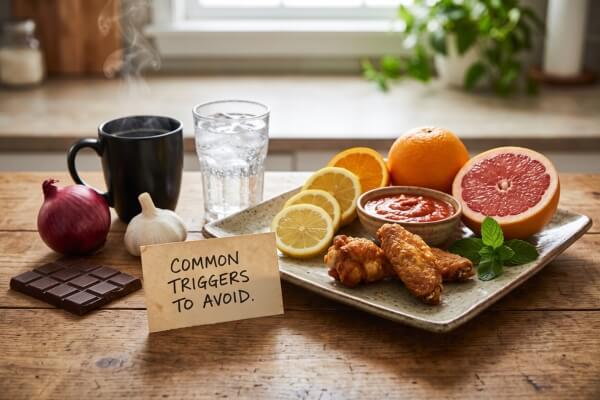
10 Common Acid Reflux Trigger Foods
1. High-Fat and Fried Foods
Fatty foods are among the most reliably reported reflux triggers, and there's a clear mechanical reason why: high-fat meals sit in your stomach longer, which gives stomach contents more time and opportunity to travel back up.
Common examples include:
French fries (chips)
Fried chicken
Fast food burgers
Potato chips (crisps)
Fried snacks
Heavy cream sauces
Fatty cuts of beef or pork
Full-fat dairy products
Baked, grilled, steamed, or air-fried versions of the same foods tend to sit much more easily.
2. Tomatoes and Tomato-Based Products
Tomatoes are naturally acidic, and that acidity can challenge digestive comfort for some people with GERD — though, as you'll see below, this is actually one of the more contested trigger foods in newer research.
Foods to watch for:
Tomato sauce
Marinara sauce
Pizza sauce
Ketchup
Salsa
Tomato soup
Plenty of people handle small amounts just fine, while others notice symptoms after a single bite.
3. Citrus Fruits and Citrus Juice
The natural acids in citrus fruits can irritate an esophagus that's already sensitive or inflamed.
Common triggers include:
Oranges
Grapefruit
Lemons
Limes
Citrus juices
If citrus tends to set you off, lower-acid fruits like bananas, melon, or pears are usually a safer bet.
4. Chocolate
Chocolate shows up on almost every reflux trigger list, and for good reason — it contains compounds that may relax the LES, plus caffeine and fat, both of which can independently make reflux more likely.
Tolerance varies a lot here. Some people can handle a small square of dark chocolate without issue; others find that even a little brings on symptoms.
5. Coffee and Caffeinated Drinks
Coffee is one of the most commonly reported triggers of all.
Potential problem beverages include:
Regular coffee
Espresso drinks
Energy drinks
Strong black tea
Certain pre-workout beverages
Interestingly, reactions here are far from universal — some people tolerate coffee just fine, especially in small amounts and alongside food rather than on an empty stomach.
6. Alcohol
Alcohol can worsen reflux both by relaxing the LES and by irritating the digestive tract directly.
Common triggers include:
Wine
Beer
Cocktails
Spirits
Symptoms tend to be worse when alcohol is paired with a large or high-fat meal, which, unfortunately, describes a lot of the situations alcohol typically shows up in.
7. Mint and Peppermint
This one surprises people. Peppermint is often marketed as a digestive support, but for people with reflux, it can actually do the opposite by relaxing the LES.
Potential triggers include:
Peppermint tea
Mint candies
Peppermint gum
Mint-flavored (flavoured) desserts
If you've noticed heartburn creeping in after a peppermint tea or an after-dinner mint, this is likely why.
8. Spicy Foods
Spicy food doesn't cause GERD, but it can absolutely challenge your digestive balance once you already have it.
Common examples include:
Hot peppers
Chili powder
Hot sauce
Spicy curries
Cayenne pepper
Tolerance for spice varies enormously from person to person, so there's no reason to cut it out preemptively unless you've noticed it's actually a problem for you.
9. Carbonated Beverages
The carbonation itself is the issue here — all those bubbles expand in your stomach, increasing internal pressure, which can push contents back up toward the esophagus.
Examples include:
Soda
Sparkling water
Energy drinks
Carbonated flavored (flavoured) beverages
Some people can get away with a small glass; others notice symptoms almost immediately.
10. Onions and Garlic
Raw onions are a frequently reported trigger, and garlic can cause problems for some people, too — though cooking often changes the equation.
You may find that:
Raw onions are genuinely problematic
Cooked onions are much better tolerated
Small amounts of garlic don't cause issues, even if large amounts do
Testing your own tolerance carefully, rather than assuming the worst, is often the better approach.
Foods You May Not Need to Avoid After All
One of the biggest myths about acid reflux is that everyone needs to cut out the exact same foods — and the more recent research actually pushes back on this pretty firmly.
A 2026 evidence review put actual numbers on this: spicy food was a reported trigger for 62% of individuals managing GERD (GORD), and tomato-based products for 52%. Those are real, common triggers — but notice what the numbers also mean: roughly 4 in 10 people with GERD have no problem with tomatoes at all, and nearly as many can eat spicy food without issue. A growing number of gastroenterologists now favor (favour) this kind of tailored, symptom-guided approach — using tools like the GERD-Q symptom questionnaire to track individual responses — over broad, one-size-fits-all restriction. Older reflux advice tended to hand out long "forbidden foods" lists almost automatically; newer clinical guidance increasingly treats that approach as outdated, given how much trigger foods vary from person to person.
In practice, this means that tomatoes, coffee, and chocolate may cause zero symptoms for you, even though they're near-universal fixtures on older reflux food lists. If a food doesn't bother you, there's usually no compelling reason to eliminate it just because it's on somebody else's list. It's also worth remembering that "healthy" and "GERD-friendly" aren't the same thing — plenty of the foods above are perfectly nutritious in general, but they just happen to be common triggers for some people.
The Hidden Trigger Most People Never Consider: Large Glasses of Water
Here's a counterintuitive one. Most people assume more water is always the healthier choice, and generally it is — but drinking large amounts of liquid during meals can temporarily stretch your stomach and increase internal pressure, which makes reflux more likely in some people.
The mechanical adjustment isn't drinking less water overall to support your digestion. It's shifting when you drink it — sipping fluids steadily throughout the day and saving most of your water intake for between-meals rather than alongside meals.
Why Late-Night Healthy Snacks Can Cause Heartburn
Timing gets overlooked far more often than it should. Even a genuinely gentle, healthy snack — oatmeal (porridge), yogurt (yoghurt), a piece of fruit — can trigger reflux if you eat it right before lying down.
Multiple recent clinical reviews point to the same conclusion: eating within a couple of hours of bedtime meaningfully increases the risk of nighttime reflux, largely because lying down removes gravity's usual assist in keeping stomach contents where they belong. This is true almost regardless of what you eat.
Eating Habits Matter Too
Sometimes the issue isn't really the food — it's the way or the timing of the eating itself. According to broad public health guidelines from the US FDA and the UK's National Health Service (NHS), maintaining a balanced diet and a healthy weight are foundational for general metabolic health. Integrating these habits simultaneously supports your holistic digestive wellness. Habits that tend to help include:
Eating smaller meals rather than large ones
Avoiding overeating in general
Staying upright for a couple of hours after eating
Finishing dinner at least 2–3 hours before bedtime
Sleeping on your left side, which helps keep the junction between your stomach and esophagus above the level of stomach acid
Maintaining a healthy weight, even modest weight loss, has been linked to promoting meaningful digestive wellness and balance in people who are overweight
Avoiding tight clothing around the waist, which adds extra abdominal pressure
These lifestyle habits often do as much heavy lifting as diet changes alone, and in some studies, weight management specifically has supported some of the most meaningful symptom management of any single intervention.
The New Research Focus: Fiber (Fibre) Instead of Restriction
One of the more genuinely interesting shifts in recent GERD research is a move away from "what should I cut out" and toward "what should I add in" — specifically, fiber (fibre).
The Nurses' Health Study II — a long-running cohort of over 116,000 women — found that higher fiber (fibre) intake was linked to supporting daily digestive comfort and maintaining esophageal balance, and the association held up even among women already taking acid-reducing medication. A separate clinical trial pushed this further by giving a group of low-fiber-intake individuals managing GERD (GORD) a fiber supplement for just 10 days. The results were striking: the number of patients reporting heartburn dropped from 93% at the start of the trial to 40% by the end, and esophageal testing showed a real physical change — the lower esophageal sphincter held stronger resting pressure, meaning it was functioning as a valve more effectively.
Good sources of fiber to lean on include:
Oats
Brown rice
Quinoa
Vegetables
Beans, if you tolerate them well
Chia seeds
Ground flaxseed
Rather than starting from a place of "what am I not allowed to eat," it can be more productive — and considerably less discouraging — to ask "how can I work more fiber into my meals this week?"
The Bigger Picture: Overall Diet Pattern Matters, Not Just Single Foods
Most of this guide is organized around individual foods, since that's usually where people start. But some of the most compelling recent research focuses on overall eating patterns — and the numbers are hard to ignore.
A 2025 cross-sectional study of 817 people found that following a Mediterranean-style GERD diet (GORD diet) — heavy on vegetables, fruit, olive oil, and fish, light on processed and fried food — was associated with significantly better digestive resilience and natural GERD (GORD) management, even after accounting for age, sex, and other lifestyle factors. Separately, a meta-analysis of randomized controlled trials found that low-carbohydrate diets produced a statistically significant reduction in esophageal acid exposure time — a direct, measurable drop in how much time acid actually spends sitting in the esophagus, not just a change in reported symptoms.
There's also a newer, more forward-looking thread of research worth knowing about: a UK Biobank study following over 500,000 participants is now examining how genetics interact with diet to influence GERD risk, including the risk of more serious complications like Barrett's esophagus. Early findings suggest people with a higher genetic risk for reflux may benefit even more from dietary improvements than people at average genetic risk — a reminder that "eat better" isn't just generic advice; it may matter more for some people than others, based on factors outside their control.
None of this replaces figuring out your personal trigger foods. But if you've already nailed down your individual list and still aren't seeing enough improvement, shifting your overall diet pattern to support daily wellness — not just avoiding specific foods — may be the next lever worth pulling.
Sample Acid Reflux-Friendly Day
Breakfast: Oatmeal topped with banana slices and chia seeds
Lunch: Grilled chicken, rice, and steamed vegetables
Snack: Pear and a handful of almonds
Dinner: Baked salmon, roasted sweet potatoes, and green beans
Evening: Herbal tea (non-mint), finished at least a couple of hours before bed
For comprehensive meal strategies, explore our Holistic Reflux Support Guide to maintain long-term digestive balance.
The Bottom Line
There's no universal list of foods every person with acid reflux has to avoid — and current research increasingly backs that up, rather than treating it as wishful thinking. That said, fatty and fried foods, tomatoes, citrus, chocolate, caffeine, alcohol, mint, spicy foods, carbonated drinks, onions, and garlic remain the most commonly reported triggers, and they're a reasonable starting point if you're not sure where to look first.
Instead of eliminating a dozen foods at once out of caution, it's usually more effective — and much more sustainable — to identify your specific triggers. A simple symptom diary, smaller and slower meals, more fiber, better timing around bedtime, and a few key lifestyle habits can meaningfully manage reflux symptoms while still leaving you with a genuinely varied, enjoyable diet.
Want to take the guesswork out of your meals? Discover more flavor-packed (flavour-packed), low-acid recipes designed by a holistic nutrition consultant: