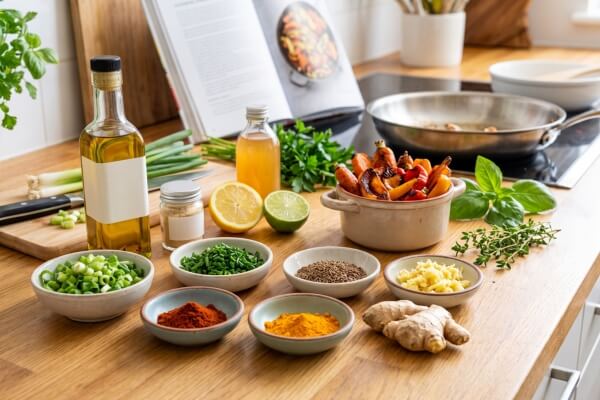
Replace Onion & Garlic on a Low FODMAP Diet
For most people beginning a low FODMAP diet, losing onion and garlic feels worse than losing anything else.
They're the base of nearly everything: soups, sauces, curries, stir-fries, marinades, casseroles, salsa, dressings. Take them out of a familiar recipe and it doesn't just taste different — it tastes unfinished, flat and oddly sweet, like a song missing its bassline.
This is frustrating precisely because neither lacks nutritional value. Both are rich in fructans, a fermentable carbohydrate that challenges natural digestive wellness in some people managing IBS, so both get reduced during the elimination phase and tested again later.
The mistake almost everyone makes is hunting for one ingredient that replaces onion and garlic on a low FODMAP diet. Nothing does. What they provide is six different things at once: aroma, savory (savoury) depth, sweetness, sharpness, freshness, and complexity. You rebuild those jobs separately.
Start here: garlic-infused oil
This is the single most useful substitute, and it works because of a quirk of chemistry. Fructans are water-soluble but not fat-soluble. Garlic's aromatic compounds move into oil; the fructans largely stay behind.
That makes infused oil the workhorse of low FODMAP cooking — pasta, stir-fries, roasted vegetables, fish, chicken, potatoes, grain bowls, dressings. Use it as the cooking fat wherever a recipe says to sauté minced garlic.
One label detail that matters: buy oil made with infused garlic, not "garlic extract" or "garlic flavor (flavour)." Extract-based products may not follow the same fructan logic. Certified low FODMAP products have been tested, which removes the guesswork.
The safety part, which most articles bury
I'm putting this here rather than at the bottom, because garlic-infused oil appears in nearly every suggestion below and the risk is real.
Fresh garlic sitting in oil at room temperature is one of the best-documented causes of home-prepared botulism. Garlic grows in soil, soil carries Clostridium botulinum spores, and submerging fresh garlic in oil creates exactly what those spores need: no oxygen, low acid, room temperature. The US Centers for Disease Control and Prevention (CDC), alongside the UK's Food Standards Agency (FSA), has tracked more than 40 confirmed botulism outbreaks linked to garlic-in-oil since 1970 to promote public food safety.
This isn't a hypothetical from a cautious extension office. In 1989, three people in New York were hospitalized after eating garlic bread made with a commercial garlic-in-oil product. The US FDA, aligning with international safety standards from the FSA and NHS, responded by requiring all commercial garlic-in-oil products to be acidified or preserved — which is exactly why the bottle from the shop is safe and your jar on the counter isn't.
And you cannot detect it. Contaminated oil looks, smells, and tastes completely normal.
So:
Simplest and safest: buy it. Commercial infused oils are acidified by law and shelf-stable.
If you make it: heat the oil with the garlic, strain out every solid piece, refrigerate immediately, and use within two to four days. Discard anything left at room temperature for more than two hours.
Dried garlic is a safe alternative for infusing, because without water the spores can't grow. Heat oil to about 180°F (82°C), pour over the dried ingredient, seal, cool.
Never store fresh garlic in oil on the counter, however good it looks in a bottle.
For everyday cooking, commercial is genuinely the sensible choice here.
Don't cook garlic in soup and fish it out
You'll see this advice constantly: simmer a whole clove, remove it before serving. It doesn't work, and the reason is the same chemistry that makes infused oil work in reverse.
Fructans are water-soluble. In broth, soup, stew, or any water-based sauce, they leach out of the garlic and into the liquid. Removing the visible clove afterward removes nothing that mattered. Same for onion.
The same caution applies to stock. Look for stock made without onion and garlic, or a product independently tested as low FODMAP — the infused-oil principle does not transfer to water.
Rebuilding the six jobs
Freshness and bite
Scallion (spring onion) greens are the easiest onion substitute — only the green tops, never the white bulb. They give you the fresh, slightly sharp note that vanishes with regular onion. Because regularonion isusually cooked long and slow at the start of a recipe, and scallion greens are better with brief cooking, add them near the end. For more depth, cook some early and reserve some to finish.
Chives do the same job where raw onion would normally appear: potato salad, egg dishes, dips, yogurt sauces, dressings, mashed potatoes. They're delicate, so add them late.
Mashed potatoes with garlic-infused oil, chives, and black pepper aren't identical to the onion version. It still has aroma, sharpness, and freshness, which is the point.
Savory depth
Asafoetida (hing) is the closest thing to an onion-garlic flavor in a jar. In tiny amounts — a pinch, no more — it delivers a genuinely allium-like savoriness (savouriness). Raw, it smells alarming; briefly bloomed in hot oil, it rounds out completely. Add it to hot oil before anything else, then build the dish on top. It's excellent in lentil dishes, curries, rice, and roasted vegetables.
Check the label. Most commercial asafoetida is compounded with wheat flour, which matters if you're also gluten-free or coeliac.
Ginger doesn't taste like garlic, and that's why it works. When onion and garlic go, dishes lose their aromatic top note — ginger restores intensity without attempting an imitation. Garlic-infused oil plus ginger plus scallion greens is a genuinely good base for stir-fries, noodles, soups, and marinades.
Spices, used harder than you think you need. Onion and garlic hide weak seasoning; without them, you'll notice the gaps. Cumin, coriander, smoked paprika, turmeric, cinnamon, mustard seed, fennel seed, black pepper, chili if you tolerate it. Toast them in oil for 20–30 seconds before adding liquid — it makes a dramatic difference.
The blend problem
Taco seasoning, curry powder, Cajun spice, barbecue rubs, "vegetable seasoning" — most contain garlic or onion powder, and it's easy to miss because there's nothing visibly onion-shaped in the dish. Packaged sauces, marinades, dips, and condiments are the same story.
Mix your own instead. Taco: cumin, smoked paprika, oregano, black pepper, plain chili powder. Curry-style: cumin, coriander, turmeric, ginger, a pinch of asafoetida.
Character
Use fresh herbs as ingredients, not garnish— enough to actually change the flavor (flavour). Match them to the dish rather than scattering parsley over everything:
Italian: basil, parsley, oregano
Mediterranean: parsley, dill, lemon
Mexican-inspired: cilantro, cumin, lime
Roast vegetables: rosemary, thyme, black pepper
Fish: dill, chives, lemon
This gives the meal its own identity, so it stops reading as a normal recipe with something removed.
Brightness
Often what feels like "missing onion" is actually missing contrast. Before reaching for more salt, taste a finished soup or grain bowl, add a teaspoon or two of lemon juice, and taste again. It frequently solves the problem outright.
Lemon, lime, rice vinegar, apple cider vinegar, red wine vinegar all work. Balsamic has a portion limit— keep it to about 2 tablespoons, since larger amounts push into high FODMAP territory on fructose.
Citrus zest does something different from juice: aromatic oils rather than acidity. Garlic-infused oil, lemon zest, and dill makes an excellent fish marinade with no garlic in it. Reach for zest when food tastes flat but doesn't need to be more sour.
Sweetness and browned depth
This is the job people forget. Slow-cooked onion contributes sweetness and browned savory notes, so if you delete the onion and boil everything together, the result tastes thin no matter how many herbs you add.
Create browning deliberately elsewhere: roast vegetables until the edges caramelize, sear the chicken or fish, brown the tofu, toast the grains, roast the peppers. Instead of a pale soup from broth and vegetables, roast the carrots first, then blend. The missing onion becomes much less noticeable.
Bell pepper (sweet pepper) can cover some of onion's sweetness and body, finely chopped and cooked slowly in infused oil. But watch the portion, and pick the right color (colour). Monash retested peppers and reclassified red capsicum from "eat freely" to portion-controlled — red is low FODMAP at roughly 43g, about a quarter of a pepper, because of fructose. Green pepper is the more generous choice at around 75g, roughly a whole one. If you want pepper doing real work in a sauce, green gives you more room.
Because it's sweeter than onion, balance it with herbs, black pepper, vinegar, or smoked paprika.
Mustard restores the sharp bite that disappears with raw onion — good in dressings, marinades, potato dishes, and yogurt dips. Check the jar for garlic during elimination.
A dressing that covers four jobs at once: garlic-infused olive oil, lemon juice, Dijon, black pepper, chopped chives.
The Formula
For almost any savory (savoury) recipe, pick one item from three or four of these categories:
Aromatic base: garlic-infused oil, ginger, asafoetida
Onion-like freshness: scallion (spring onion) greens, chives
Savory (Savoury) depth: cumin, smoked paprika, coriander, mustard, toasted spices
Character: basil, parsley, dill, cilantro
Brightness: lemon, lime, vinegar
Browning: roasted vegetables, seared protein, toasted grains
You don't need all six. Three or four is usually plenty.
Pasta sauce: garlic-infused oil + finely diced green pepper + smoked paprika + basil + oregano + black pepper + tomato. Finish with fresh basil and a splash of balsamic.
Stir-fry: garlic-infused oil + ginger + scallion greens. Finish with lime, cilantro, and sesame.
Curry: oil + pinch of asafoetida + ginger + cumin + coriander + turmeric. Finish with cilantro and lime.
Five combinations to memorize
Mediterranean— infused oil, lemon zest, parsley, oregano, black pepper. Fish, chicken, potatoes, grain bowls.
Asian-inspired— infused oil, ginger, scallion (spring onion) greens, rice vinegar, sesame. Tofu, rice, noodles.
Mexican-inspired— infused oil, cumin, smoked paprika, cilantro, lime. Rice bowls, roasted vegetables.
Indian-inspired— oil, pinch of asafoetida, ginger, cumin, coriander, turmeric. Lentils, rice, vegetables.
Fresh herb— infused oil, chives, dill, lemon, mustard. Fish, potatoes, salads, yogurt sauces.
What about garlic and onion powder?
Not during elimination. They're made from the same fructan-rich ingredient, just dried and ground. They also turn up unannounced in seasoning blends, crackers, stocks, sauces, deli meats, marinades, and flavored (flavoured) chips — so labels matter more than you'd expect.
A note on FODMAP lists going stale
Worth knowing: Monash periodically retests foods, and the ratings change. Red capsicum, tomatoes, grapes, and strawberries have all had their serving sizes revised downward after retesting — the researchers attribute the differences to things like climate, fertilizers, storage, and selective breeding.
Which means a printed list from a few years ago may be quietly wrong. The app is the current source.
And this is temporary
The elimination phase isn't meant to establish a permanent blacklist. Onion and garlic contain prebiotic fructans that feed beneficial gut bacteria, and tolerance varies enormously between people.
Through structured reintroduction you may find that a little cooked onion is fine, that garlic troubles you more than onion, that small portions work while large ones don't, or that both can return in moderate amounts. You only get that information by testing.
So the point of everything above isn't to convince you that onion and garlic are bad. It's to make the restricted phase pleasant enough that you actually complete it properly — and get to the part where foods come back.
If you are actively stocking your pantry, review our Low-FODMAP Grocery List for Beginners to ensure you have the right foundational ingredients.
The Bottom Line for Low FODMAP Cooking
The biggest mistake is deleting onion and garlic and changing nothing else. That's how low FODMAP food gets its reputation.
Rebuild instead: infused oil for aroma, scallion greens or chives for freshness, spices for depth, herbs for character, acid to brighten, browning for the sweetness onion used to provide.
Cook that way and the food stops tasting like a restricted version of a real recipe. It starts tasting like something designed to be good on its own terms.
References
Monash University FODMAP Program — low FODMAP diet, flavor (flavour) alternatives, and food retesting updates.
Chey WD, et al. AGA Clinical Practice Update on the Role of Diet in Irritable Bowel Syndrome. Gastroenterology. 2022;162(6):1737–1745.
Penn State Extension. How to Safely Make Infused Oils. Updated 2024.
St. Louis ME, et al. Botulism from chopped garlic: delayed onset of neuroparalytic illness. American Journal of Epidemiology, 1990.
U.S. Food and Drug Administration — acidified foods requirements for commercial garlic-in-oil products.
USDA Food Safety and Inspection Service — guidance on herb and vegetable oil infusions.
Custom HTML/CSS/JavaScript