Morning Reflux: Evening Habits to Soothe Digestion
You go to bed feeling fine. You wake up with a sour taste, a burning throat, a cough you can't clear, and the distinct sense that something came back up while you weren't looking.
Breakfast gets the blame. It usually shouldn't. What you're feeling at 7 a.m. often started at 9 the night before.
Reflux happens when stomach contents move backward into the esophagus (oesophagus). Upright, gravity helps and you swallow constantly. Asleep, you lose both — swallowing and saliva production drop, and you spend hours horizontal. Refluxed material stays in contact with the esophagus longer, which is why nighttime reflux is linked with disrupted sleep and worse daytime functioning, and why the aftermath is what greets you in the morning.
First, an honest word about the evidence
Everything below is worth trying. Most of it also rests on weaker evidence than the confident tone of most reflux articles suggests, and you should know which is which.
In the 2022 ACG guideline, exactly one lifestyle recommendation is graded strong: weight loss in people who are overweight or obese. Every other one — avoiding meals within two to three hours of bedtime, avoiding trigger foods, stopping smoking, elevating the head of the bed — is a conditional recommendation based on low-quality evidence.
That doesn't mean they don't work. Conditional means the evidence is thin, not that the advice is wrong, and some of these interventions are nearly free to try. But it does mean the right approach is personal experimentation rather than adopting a universal list of bans. I'll flag the strength as we go.
1. The gap between your last food and lying down
This is the one with the most direct supporting research, and it's the place to start.
Broad digestive wellness guidelines from the US National Institute of Diabetes and Digestive and Kidney Diseases (NIDDK), the American College of Gastroenterology (ACG), and the UK's National Health Service (NHS) recommend finishing meals at least three hours before lying down to support digestion when nighttime reflux is a challenge. A randomized crossover study gave people with reflux the same meal either two hours or six hours before bed — the two-hour version produced significantly more supine acid reflux, with the effect strongest in people who were overweight or had a hiatal hernia or esophagitis.
Three things quietly break this rule even when you think you're following it.
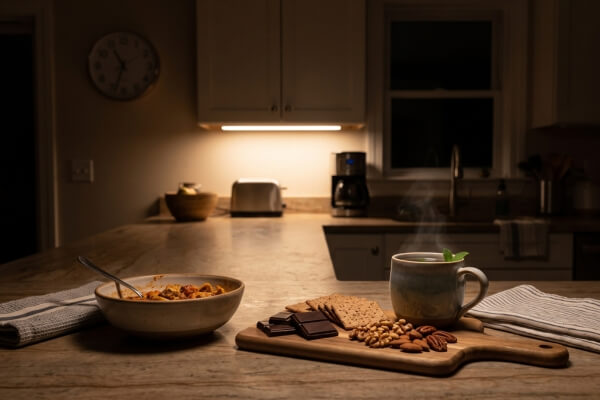
Late snacking. Dinner at 7:30, then nuts at 8:30, yogurt (yoghurt) at 9, chocolate at 9:30, crackers at 10. Technically, you ate dinner three hours before bed. Your stomach got no such gap. The interval is between eating and lying down, not between the meal labeled dinner and lying down.
Saving the day's food for the evening. Coffee for breakfast, small salad for lunch, too busy for anything else, then an enormous dinner because you're ravenous. That meal is larger than your stomach comfortably handles at once, and stomach distension promotes reflux. The fix isn't willpower at 9 p.m. — it's eating properly at noon.
Late workouts. Finish at 8:30, big recovery meal at 9, bed at 10. Evening exercise doesn't cause reflux. It just tends to push the day's largest meal against bedtime. Eat more earlier, keep the post-workout meal modest, or move the session if you can.
Practical target: if you go to bed at 11, finish eating around 8. There's nothing special about 6 p.m. — dinner at 8 with a midnight bedtime is fine; dinner at 8 with a quarter-to-nine bedtime isn't.
2. How rich that late meal is
A dinner can be nutritionally excellent and still be a lot of fat arriving at once: salmon, avocado, nuts, tahini dressing, olive oil, then dark chocolate. High-fat foods are among the commonly reported triggers, though responses vary a great deal between individuals.
Salmon with vegetables and rice tends to sit better than salmon with avocado, nuts, creamy dressing, and chocolate — particularly close to bedtime. Improving the quality of the fat doesn't change the quantity arriving in one late meal.
3. Trigger foods — test them, don't ban them
Chocolate, alcohol, caffeine, and mint are the usual suspects, and each has a particular evening logic:
Chocolate after dinner stacks volume, fat, and a possible trigger with almost no time before bed. Someone who's fine with chocolate at 2 p.m. may not be at 10.
Alcohol rarely arrives alone — it usually comes with a large meal, fatty food, snacks, and a later bedtime, which makes it hard to isolate.
Caffeine has a double effect: possible trigger, plus impaired sleep in susceptible people. Breakfast coffee may be fine while the after-dinner espresso isn't.
Peppermint tea is the sneaky one, because people drink it specifically when their stomach feels off. Mint is a commonly reported trigger. Same applies to mint sweets, gum, and mint-flavored desserts.
Here's the honest framing. ACG's recommendation to avoid trigger foods is conditional and based on low-quality evidence, and an earlier version of the guideline stated plainly that routine global elimination of foods like chocolate, caffeine, alcohol, and spicy food is not strictly recommended for managing GERD diet support. There's a shortage of studies showing symptom improvement from cutting any of them across the board.
So don't ban anything preemptively. Remove one suspect for a week or two while holding the rest of your routine steady, and see what happens. If nothing changes, you've learned that and can have it back — which is worth more than a permanent restriction you adopted on a hunch.
4. What your body is doing after dinner
Staying upright matters, and not only in bed. Dinner ends, you move to the couch, recline nearly flat, and stay there two hours. You've given up most of gravity's help without being asleep. You don't need to stand rigidly for three hours — sit properly, clear the kitchen, prep for tomorrow, take an easy walk. Just avoid large meals, then immediately horizontal.
Raise the head of the bed if nights are the problem. ACG suggests this for nighttime symptoms (conditional, low evidence). Stacking pillows mostly bends you at the waist while your torso stays flat. A wedge, or risers under the head end of the bed frame, elevates the upper torso properly.
And try your left side. This is the most interesting finding in reflux research and it costs nothing.
A 2023 systematic review and meta-analysis found left-side sleeping produced significantly lower esophageal acid exposure and faster acid clearance than either right-side or supine sleeping. A double-blind, randomized, sham-controlled trial in 100 people used a wearable device that vibrates when you roll onto your right side, training people toward the left — it increased left-side sleeping and reduced nocturnal reflux symptoms compared with sham. A follow-up study using pH-impedance monitoring in 30 patients confirmed the effect on objective acid measurements, not just symptoms.
One correction worth making, because it changes the advice: the meta-analysis found no difference between right-side and back sleeping. The benefit is in getting to the left, not in avoiding the right specifically. If you sleep on your back, switching left may help; you weren't doing something uniquely wrong before.
Keep the evidence in proportion — the objective outcomes rest on two non-randomized studies plus one RCT. It's promising rather than proven. It's also free.
The intervention that isn't an evening habit at all
Here's the thing an article about evening routines structurally can't deliver.
Weight loss is the only lifestyle recommendation ACG grades as strong, and it's the only one supported by moderate rather than low-quality evidence. If you're carrying extra weight — particularly around the abdomen, which raises pressure on the stomach — that's the highest-yield change available, and it doesn't happen between 7 p.m. and bedtime.
Smoking cessation also appears in the guideline, and rarely in evening-habit lists.
Neither is as tidy as moving dinner earlier. Both matter more than most of what's above.
Change one thing at a time
If you alter ten things tonight and feel better tomorrow, you've learned nothing and acquired nine unnecessary rules.
A sensible order:
Widen the eating-to-lying-down gap. Biggest effect, easiest to test.
Then shrink very large evening meals and late snacks.
Then test suspected triggers individually— alcohol, chocolate, mint, caffeine.
Then try head elevation and left-side sleeping.
That's an experiment. A list of forbidden foods is not.
If you already do all of this
If you leave hours between eating and bed, keep dinner moderate, know your triggers, sleep elevated and on your left — and still wake up with significant reflux — the answer isn't another lifestyle adjustment.
GERD is a medical condition that often requires medication. ACG recommends proton pump inhibitors for established erosive reflux disease, and endoscopy when alarm symptoms are present. Lifestyle measures are genuinely useful and genuinely insufficient on their own for a lot of people.
Consult a healthcare professional if reflux is frequent, worsening, or repeatedly disrupting your sleep — and promptly for difficulty or pain on swallowing, food sticking, bleeding, black stools, persistent vomiting, unexplained weight loss, anemia, or significant chest pain. Don't self-diagnose chest pain as heartburn.
To build a comprehensive approach, exploring a balanced acid reflux diet can naturally support your daily routine.
The bottom line
Morning reflux usually begins the night before, and the highest-value evening changes are the dullest ones: leave a real gap between your last food and lying down, keep dinner moderate, and stay upright afterward.
After that, test your own triggers one at a time rather than inheriting someone else's banned list. Raise the head of the bed. Try your left side.
And keep the honest caveat in view — most of this rests on low-quality evidence, and the single strongest lifestyle recommendation in the guidelines isn't an evening habit at all. Changing your last three hours before sleep will probably do more for morning reflux than changing breakfast ever will. It may not be the only thing you need to change.
References
Katz PO, Dunbar KB, Schnoll-Sussman FH, Greer KB, Yadlapati R, Spechler SJ. ACG Clinical Guideline for the Diagnosis and Management of Gastroesophageal Reflux Disease. American Journal of Gastroenterology. 2022;117(1):27–56.
National Institute of Diabetes and Digestive and Kidney Diseases. Acid Reflux (GER & GERD) in Adults — Treatment.
Simadibrata DM, Lesmana E, Amangku BR, Wardoyo MP, Simadibrata M. Left lateral decubitus sleeping position is associated with improved gastroesophageal reflux disease symptoms: A systematic review and meta-analysis. World Journal of Clinical Cases. 2023;11(30):7329–7336.
Schuitenmaker JM, et al. Sleep Positional Therapy for Nocturnal Gastroesophageal Reflux: A Double-Blind, Randomized, Sham-Controlled Trial. Clinical Gastroenterology and Hepatology. 2022;20(12):2753–2762.
Schuitenmaker JM, et al. The effect of sleep positional therapy on nocturnal gastroesophageal reflux measured by esophageal pH-impedance monitoring. Neurogastroenterology & Motility. 2023;35(8):e14614.
Piesman M, Hwang I, Maydonovitch C, Wong RK. Nocturnal reflux episodes following the administration of a standardized meal. Does timing matter? American Journal of Gastroenterology. 2007;102(10):2128–2134.
Custom HTML/CSS/JavaScript