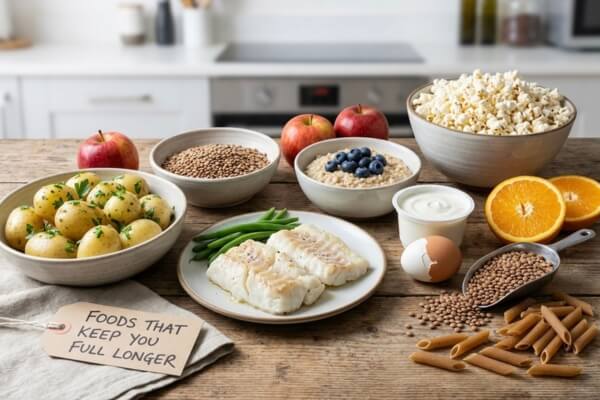
10 Satiety Index Foods That Keep You Full Longer
You finish a meal. You wash the plate. Forty minutes later, you're standing in front of the refrigerator with the door open, not really hungry but not really not hungry either.
Most of us assume the fix is eating more. However, much like other common digestive health myths, relying solely on larger portions rarely supports sustained daily wellness. Two meals with identical calories can leave you in completely different places two hours later — and over the last few years, researchers have gotten much better at explaining why.
What We Know About the Satiety Index
Most articles on this topic lean on a single study: the Satiety Index, published in 1995 by Susanna Holt's team at the University of Sydney. They fed volunteers 240-calorie portions of 38 different foods and tracked hunger every fifteen minutes for two hours. White bread was set at 100; everything else was scored against it.
It's a genuinely useful study and I'll cite it below. But it's worth saying plainly: it has never been properly replicated at scale. Holt's group extended the method in 2001, and a US Army team built a related index for military rations in 2004, but there is no large modern redo of the original 38-food table. The numbers you see reposted endlessly online all trace back to 11 to 13 people per food, over a two-hour window, thirty years ago.
The good news is that the last seven years have produced much better evidence about fullness — and it mostly supports the same conclusions while explaining them differently. That newer work is in the section after the list, and it's arguably the more important part.
10 Fiber Foods That Naturally Support Fullness
1. Potatoes
As one of the highest-ranking satiety index foods, plain boiled potatoes topped the whole table at 323 — over three times white bread, and roughly seven times a croissant.
Potatoes have spent two decades on the nutritional naughty list, mostly by association with french fries (chips) and potato chips (crisps). But a plain boiled potato is about 77% water, contains fiber (fibre) and resistant starch, and acts as an easy-to-digest food that gently soothes your stomach while delivering potassium with essentially no fat. Calorie for calorie it's enormous — a 240-calorie serving of potato weighs several times more than 240 calories of most other foods, and that physical bulk in your stomach is a real signal.
One useful trick: cooking potatoes and then chilling them lets some of the starch recrystallize into resistant starch, which behaves more like fiber (fibre) than sugar. Lab work has confirmed chilled cooked potatoes carry meaningfully more of it than hot. The effect in real people is modest, so this isn't a miracle solution — but it does mean yesterday's potatoes are excellent foods that keep you full and support natural body balance.
Try them: boiled and chilled in a potato salad with mustard vinaigrette, mashed with olive oil instead of butter, or diced into a brothy soup.
2. White Fish
Fish scored 225 in 1995 — the highest of any protein food tested, ahead of beef, eggs, and cheese by a wide margin.
Part of that is protein density; part is water. A fillet of white fish is mostly protein and moisture with very little else, so you get a large, heavy portion for very few calories. Cod, haddock, pollock, and hake all fit this profile. Oily fish like salmon and mackerel are more calorie-dense but bring omega-3 fats along with the protein.
Try it: baked cod with herbs and potatoes, canned sardines mashed onto toast, or a fish stew with tomatoes and white beans.
3. Oats
Oatmeal (porridge) scored 209 — the highest breakfast cereal tested. Muesli, for comparison, scored exactly 100.
The active ingredient is beta-glucan, a soluble fiber (fibre) that dissolves into a viscous gel in the gut, slowing how quickly your stomach empties. That's why oatmeal (porridge) at 8 a.m. still counts for something at 11.
Beta-glucan is also one of the very few food compounds regulators on both sides of the Atlantic agree on. Broad digestive health guidelines from the US Food and Drug Administration (FDA) and the UK's Food Standards Agency (FSA) acknowledge that about 3 grams of oat or barley beta-glucan daily helps support cardiovascular resilience — roughly a cup and a half (approx. 350ml) of cooked oatmeal (porridge).
Because the gel does the work, heavily processed and finely milled oat products lose some of the effect. Steel-cut and rolled oats hold up better than sweetened instant sachets.
Try them: overnight oats with berries, a savory oat bowl with a soft egg, or oats stirred into soup as a thickener.
4. Oranges
Oranges scored 202, outperforming apples, grapes, and bananas, and beating every bakery item by a distance. Holt's explanation was refreshingly unscientific: oranges take up a lot of room for very few calories.
She also noted that orange juice almost certainly wouldn't score the same despite identical calories. You can drink a glass in twenty seconds. Eating the equivalent in whole oranges takes minutes of peeling, segmenting, and chewing — and modern research on eating rate, below, suggests she was right for reasons she couldn't fully measure at the time.
Bananas scored 118, barely above white bread. Fruit is not one category.
Try them: eaten plain over the sink, segmented into a salad with fennel and olives, or sliced with cinnamon.
5. Apples
Apples are mostly water and fiber (fibre), which sounds unimpressive until you see a controlled trial.
Penn State researchers gave 58 adults one of four apple preloads before lunch — whole segments, applesauce, apple juice, or apple juice with fiber (fibre) added back — all matched for calories, weight, and energy density. The whole apple cut total lunch calories by 15% versus no preload, and beat every other form. Adding fiber (fibre) back into the juice did nothing.
That last detail is the interesting one. The fiber (fibre) wasn't the whole story. Structure was. It's a good argument for eating fruit rather than drinking it — and a reminder that a smoothie and a whole apple are not the same food.
Try them: sliced with cinnamon, grated into overnight oats, or baked soft with a spoonful of yogurt.
6. Whole Grain Pasta
Pasta on a fullness list feels wrong, which is why it's here. Brown pasta scored 188 — higher than beef, eggs, or cheese. White pasta scored 119.
That gap is mostly structure. Whole grain pasta keeps the bran layer intact, slowing how fast enzymes reach the starch. Pasta of any kind also has a dense texture that demands real chewing, and it's usually eaten hot with sauce and vegetables — bulk on bulk.
Cooking it al dente rather than soft keeps more of that resistance intact. Overcooked pasta digests noticeably faster.
Try it: whole wheat pasta with lentil ragù, cooled into a pasta salad with beans and herbs, or with tuna, lemon, and a lot of parsley.
7. Beans, Lentils, and Other Pulses
Here the evidence is genuinely contradictory, and it's worth being straight about it.
On the 1995 index, lentils scored only 133 — barely above white bread. Baked beans managed 168. Neither is near the top.
But a 2014 meta-analysis pooling nine controlled feeding trials found meals containing pulses produced about 31% more satiety than calorie-matched controls. In those same trials, people didn't eat measurably less at their next meal.
So: pulses reliably make you feel fuller in the hours after eating, they don't dominate the way potatoes do, and whether the feeling translates into eating less overall depends on you rather than the beans. Holt suggested part of the mechanism is that compounds in legumes slow their absorption.
Even so, few foods pack this much protein, fiber (fibre), and slow carbohydrate into something this cheap. A cup of cooked lentils gives you roughly 18 grams of protein and 15 grams of fiber (fibre) for well under a dollar.
Try them: lentil and tomato soup finished with lemon, chickpeas roasted until crisp, or black beans folded into a grain bowl.
8. Popcorn
Popcorn scored 154 — mid-table, roughly level with whole grain bread. Its real value is as a snack replacement.
In one trial, participants who ate six cups of plain popcorn (about 100 calories) reported less hunger and more satisfaction than those eating one cup of potato chips (about 150 calories) — more fullness from a third fewer calories. Chips themselves scored 91 on the Satiety Index: below white bread.
The mechanism isn't mysterious. Popping turns a small hard kernel into airy foam, so popcorn occupies enormous space for its weight. Your stomach responds to volume. It doesn't count calories.
This only holds for plain or lightly seasoned popcorn. (Also worth knowing: that popcorn-versus-chips study was funded by a popcorn company.)
Try it: air-popped with a light spray of olive oil, smoked paprika, and salt.
9. Eggs
Eggs scored a middling 150, which is the least interesting thing about them. The stronger evidence comes from breakfast studies.
In trials comparing an egg breakfast to a calorie-matched bagel breakfast, people eating eggs reported less hunger, ate less at lunch, and — in one study tracking men across a full day — consumed around 400 fewer calories over the following 24 hours. Blood work showed a suppressed ghrelin response; ghrelin is the hormone that tells your brain it's time to eat.
The takeaway isn't that eggs are a quick fix. As recognized by broad dietary frameworks from the US National Institute of Diabetes and Digestive and Kidney Diseases (NIDDK) and the NHS, front-loading protein simply supports steady metabolic resilience. It's that front-loading protein at breakfast changes how the rest of the day feels in a way that a bagel and coffee don't.
For transparency: much of this research was funded by egg industry bodies. The direction of the findings holds up elsewhere, but it's fair to know.
Try them: hard-boiled and salted for the refrigerator door, scrambled slowly with spinach, or baked into a frittata you can eat cold.
10. High-Protein Dairy: Greek Yogurt (Yoghurt) and Cottage Cheese
A correction that matters: plain yogurt scored 88 in 1995 — below white bread. But that was ordinary yogurt, not the strained high-protein products that dominate the dairy aisle now. Those are a different food.
Greek yogurt is strained to remove liquid whey, roughly doubling protein for the same volume — typically 15 to 20 grams per tub. Cottage cheese delivers around 12 to 14 grams per half cup, mostly slow-digesting casein.
The relevant trial: women given a 160-calorie high-protein yogurt as an afternoon snack waited about 30 minutes longer before requesting dinner than when they'd eaten chocolate, and ate roughly 100 fewer calories at that dinner. A companion study found no meaningful difference between moderate- and high-protein yogurt, so there are diminishing returns — the jump is from nothing or a chocolate bar to any decent protein snack, not from 14 grams to 24.
Neither requires preparation, which matters more than nutritionists like to admit. The food that keeps you full is the one you actually eat.
Read the label, though. Fruit-flavored versions can carry as much added sugar as dessert.
Try it: yogurt with berries and cinnamon; cottage cheese with sliced peaches and black pepper, or on rye toast with tomato.
(Both yogurt studies above involved dairy-industry funding or affiliation.)
What Didn't Make the Cut
Chia seeds. The theory is sound — chia absorbs many times its weight in liquid and gels — but the trials disappoint. A 2023 randomized, double-blind crossover study found little or no effect on subjective appetite. A 12-week trial at 50 grams daily found no significant weight change. One earlier trial using chia in yogurt did find reduced short-term intake. While they are fine fiber foods, they are not doing what the marketing claims for sustained fullness.
Peanuts and nuts generally. Peanuts scored 84 — below white bread. Nutritious, but energy-dense, so calorie for calorie you get a very small pile of food. Filling per handful, not per calorie.
Muesli. Exactly 100. Same as white bread. Granola, with added oil and sugar, is likely worse.
Anything liquid. Juice, smoothies, and drinkable yogurts consistently underperform their whole-food equivalents even when calories and fiber (fibre) are matched.
What's Changed Since 1995
This is the part most articles skip, and it's where the field has actually moved.
The strongest new evidence isn't about individual foods — it's about how fast you can eat them.
In 2019, a US National Institutes of Health (NIH) team, utilizing metabolic-ward protocols comparable to those endorsed by the UK's National Institute for Health and Care Research (NIHR), ran a trial: 20 adults spent two weeks eating an ultra-processed diet and two weeks eating an unprocessed one, with the meals matched for calories offered, sugar, fat, sodium, fiber (fibre), and macronutrients. People could eat as much as they wanted. On the ultra-processed diet they ate about 508 more calories a day and gained around 0.9 kg; on the unprocessed diet they lost about the same. Both diets were rated equally pleasant, so this wasn't about the food tasting better.
What differed was speed. Participants ate the ultra-processed food roughly 17 calories per minute faster. The plate emptied before the gut's fullness signals could arrive.
A pooled analysis of 327 foods found the same gradient, and it's striking: unprocessed foods were eaten at about 36 calories per minute, processed at 54, ultra-processed at 69. Nearly double, end to end.
The finding has since been replicated. A 2024 Japanese trial reported a difference of over 800 calories a day, and specifically measured less chewing per calorie on the ultra-processed diet. A 2025 Wageningen trial that manipulated only meal texture — holding energy density, portion size, and processing level constant — produced a cumulative difference of more than 5,000 calories across fourteen days.
And the largest real-world test: a 2025 UCL trial published in Nature Medicine put 55 adults on two eight-week diets, both designed to meet UK healthy-eating guidelines, one minimally processed and one ultra-processed. People lost roughly twice as much weight on the minimally processed version — about 2% of body weight versus 1%.
One honest caveat on that last one: the researchers had expected the ultra-processed group to gain weight, and it didn't — it lost weight too, just less. Even guideline-compliant ultra-processed food underperformed, but the effect was smaller than the metabolic-ward result suggested. Real life dampens things.
So What Actually Makes a Food Filling?
Holt's original analysis found the strongest predictor of a high score was serving weight — sheer physical mass per calorie, not protein or fiber (fibre). Stretch receptors in the stomach are among the earliest fullness signals your brain gets. Her second finding was stranger: the more palatable a food was rated, the less filling it was per calorie. Plain boiled potatoes are not exciting, and that appears to be part of why they work.
The newer research adds a third factor she couldn't isolate: how long the food takes to eat. Hard, fibrous, wet, structurally intact food slows you down. Soft, dry, dense, pre-broken-down food doesn't. Chewing is not incidental — it's most of the mechanism.
Which gives a fairly simple set of levers:
- Weight and water — soups, stews, fruit, vegetables, potatoes, fish
- Protein — eggs, dairy, fish, pulses
- Viscous fiber (fibre) — oats, barley, beans, apples
- Intact structure and slow eating — whole fruit over juice, al dente over soft, whole grain over refined, cooked-from-scratch over ready meal
Building high satiety meals by combining two or three elements naturally promotes digestive wellness better than maxing out any single one:
- Oatmeal (porridge) + Greek yogurt + berries
- Boiled potatoes + baked cod + green beans
- Lentil ragù over whole wheat pasta
- Apple + cottage cheese
The Bottom Line
Feeling satisfied after a meal usually isn’t about eating more. It’s about choosing foods that pull their weight — literally, in the case of potatoes and popcorn — and that take long enough to eat that your body can notice.
The thirty-year-old rankings are a useful map. The newer work is the better guide: cook things, chew things, and prefer food that resists you a little.