10 Healthy Foods Slowing MASLD Support
If you've been diagnosed with fatty liver disease, you've probably already made an honest effort to clean up your diet. Soda (fizzy drinks) got swapped for juice. Candy (sweets) became dried fruit. Chips (crisps) turned into nuts. Ice cream became yogurt.
On paper, those swaps look like exactly the right moves. And in a lot of ways, they are. But here's the catch: several foods with a genuinely healthy reputation can still sneak in hidden sugars, saturated fat, or excess calories that disrupt your fatty liver management — especially once portions creep up or a product turns out to be more processed than the packaging suggests.
Fatty liver disease — now more often called MASLD, or metabolic dysfunction-associated steatotic liver disease — is closely tied to insulin resistance and other metabolic risk factors. If you carry excess weight, even gradual weight loss can meaningfully reduce liver fat, and larger, sustained losses may improve inflammation and scarring too. Rapid or extreme dieting, though, tends to backfire rather than help.
None of the foods below need to be banned. Almost all of them can stay part of a liver-supportive way of eating. What actually matters is portion size, how the food was prepared, and what else got added along the way.
1. Fruit Juice
Fruit juice isn't nutritionally empty — it does carry vitamins and plant compounds. The problem is volume: it's far easier to drink the sugar equivalent of four oranges than it is to sit down and eat four actual oranges.
Juice also skips the fiber (fibre) and structure that whole fruit gives you, which is exactly what makes whole fruit filling. A big glass of juice can add a real amount of sugar without leaving you satisfied for very long afterward.
This isn't a minor point, either — current guidance from the US National Institute of Diabetes and Digestive and Kidney Diseases (NIDDK), alongside the UK's National Health Service (NHS), specifically recommends limiting drinks high in simple sugars for optimal MASLD diet support, particularly fructose-heavy sweetened beverages and juices.
A better approach: Reach for whole oranges, berries, apples, or pears most of the time. If you do drink juice, keep the pour modest. For better alternatives, explore our guide on daily liver-support hydration habits.
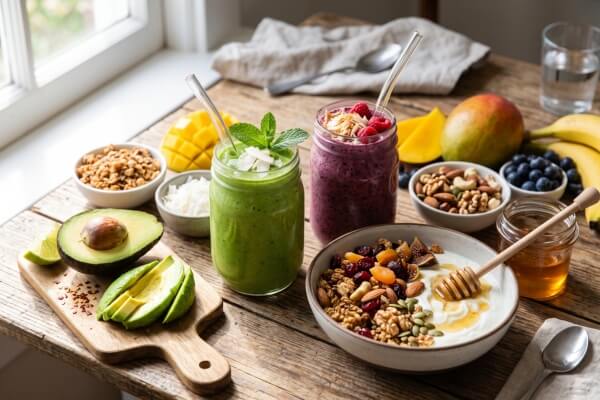
2. Large Smoothies and Smoothie Bowls
A homemade smoothie really can be nutritious. It can also, without much effort, become an entire oversized meal that doesn't look like one.
A single smoothie can quietly pack in several servings of fruit, a splash of juice, sweetened plant milk, flavored yogurt, honey, nut butter, granola, and protein powder — and every single one of those ingredients sounds wholesome on its own. Blended together, they add up fast.
Blending fruit doesn't make it unhealthy. The real issue is that liquid and semi-liquid meals make it remarkably easy to consume far more in one sitting than you would if you were eating the same ingredients with a fork.
A better approach: Build smoothies around one portion of fruit, an unsweetened liquid base, and a protein source like plain yogurt or unsweetened soy milk. Reach for spinach, oats, chia, or ground flax rather than juice, honey, or a heaping scoop of granola on top.
3. Flavored (Flavoured) Yogurt (Yoghurt) and Hidden Sugars
Yogurt (yoghurt) is genuinely good for you — it offers protein, calcium, and beneficial live cultures. Flavored (flavoured) versions, though, can carry a surprising amount of added sugar, even when the label uses phrases like "natural," "low-fat," or "made with real fruit."
Here's a detail worth knowing: low-fat yogurt isn't automatically lower in sugar. In a lot of products, sweetness gets added specifically to make up for the flavor lost when fat is reduced.
The US FDA, similar to UK Food Standards Agency (FSA) labeling standards, requires added sugars to be listed separately on the Nutrition Facts label, so sugar from syrups, fruit preparations, and sweetened flavorings all count toward that number — it's worth a quick look next time you're standing in the yogurt aisle.
A better approach: Start with plain, unsweetened yogurt and build flavor yourself — fresh berries, cinnamon, chopped fruit, or a small handful of nuts. Unsweetened soy yogurt is a solid dairy-free alternative if that's what you're after.
4. Granola
Granola sounds like oats, nuts, seeds, and whole grains — because it is, technically. But a lot of commercial granola also carries a generous amount of oil, syrup, honey, chocolate, sweetened dried fruit, or coconut.
The issue usually isn't one bad ingredient. It's concentration. Granola has very little water content, which makes it easy to pour a bowl that's several times larger than the actual serving size listed on the box.
A bowl loaded with granola can deliver far more calories than an equivalent bowl of plain cooked oatmeal, even though both technically start with the same grain.
A better approach: Treat granola as a crunchy topping, not the main event. A more filling breakfast usually comes from combining a measured portion with plain yogurt, fresh fruit, or unsweetened oatmeal.
5. Dried Fruit
Raisins, dates, dried cranberries, apricots, and prunes — all of these carry real nutrients and can absolutely fit into a healthy diet in small amounts. But once the water is removed, the sugar becomes a lot more concentrated.
A small handful of dried fruit can represent several pieces of fresh fruit's worth of sugar. Some dried fruits — cranberries, mango, banana chips, and packaged fruit snacks in particular — often have added sugar or oil mixed in on top of that.
Dried fruit isn't candy. But it's genuinely easier to overeat than fresh fruit, simply because it's so much smaller and denser.
A better approach: Use dried fruit as an ingredient rather than a snack on its own — a tablespoon stirred into oatmeal, barley, or plain yogurt works well. Check the ingredient list for added sugar or syrup before buying.
6. Nuts, Nut Butter, and the Importance of Portion Control
Nuts provide unsaturated fats, plant protein, fiber (fibre), and minerals, and they fit naturally into Mediterranean-style eating patterns, which current MASLD guidance actively recommends.
The catch is portion size. Nuts and nut butters are calorie-dense, and it's remarkably easy to eat several servings' worth while snacking straight from the bag or spooning them directly from the jar.
If you're trying to create even a modest calorie deficit, those extra handfuls can quietly cancel out progress you're making elsewhere in your diet. Institutional dietary guidance from the NIDDK and NHS specifically flags that healthy fats are calorie-dense across the board, making serving moderation essential.
A better approach: Measure out a small handful of nuts or a spoonful of nut butter, rather than eating straight from the container. Look for versions without added sugar, palm oil, or excessive salt.
7. Avocado and Oil-Heavy "Healthy" Meals
Avocado and olive oil are often smart swaps in place of butter, cream, or fatty processed meats — mostly unsaturated fat, and a natural fit for a Mediterranean-style diet.
But swapping saturated fat for unsaturated fat doesn't make portion size stop mattering. A meal built from a whole avocado, a generous olive oil dressing, tahini, nuts, seeds, and hummus can genuinely be nutritious — and still carry a lot more calories than you'd guess just by looking at it.
This shows up constantly in restaurant grain bowls and oversized "healthy" salads, where several rich, healthy-fat ingredients get stacked into a single dish.
A better approach: Keep the ingredients you love, but stop stacking every high-fat topping into the same meal. Pick avocado or nuts, not both, and measure oil-based dressings rather than pouring freely. To make informed choices, review the best and worst cooking oils for liver health.
8. Coconut Oil, Coconut Milk, and Coconut-Based Snacks
Coconut products are heavily marketed as a "natural" stand-in for butter, cream, or dairy. In reality, a lot of coconut-based foods — coconut oil, especially, along with full-fat canned coconut milk, coconut cream, and coconut desserts — deliver a substantial amount of saturated fat.
Current MASLD recommendations advise cutting back on saturated fat and limiting ultra-processed foods that are high in both saturated fat and sugar. Short-term clinical trials have also linked higher saturated fat intake to increased liver fat, not just calories.
That doesn't mean coconut has to disappear from your kitchen entirely. A small amount used for flavor is a completely different situation from making coconut oil or coconut cream your everyday go-to fat.
A better approach: Lean on unsaturated oils like olive or canola more often. For curries and soups, try light coconut milk, a smaller amount of full-fat coconut milk, or blend it with low-sodium broth to stretch the flavor.
9. Whole-Grain Crackers, Bars, and Packaged Snacks
"Whole grain" printed across the front of a package doesn't automatically mean the product is minimally processed, low in sugar, or low in sodium.
Granola bars, breakfast biscuits, crackers, protein cookies, and baked chips can genuinely contain whole grains — while also containing refined starches, sweeteners, oils, saturated fat, and concentrated flavorings right alongside them.
Current European MASLD guidance is clear on this: the recommendation is to limit ultra-processed foods rich in sugar and saturated fat as a category, rather than fixate on whether a single ingredient sounds healthy.
A better approach: Flip the package over. Compare serving size, added sugars, saturated fat, sodium, and fiber directly, rather than trusting front-of-package claims like "multigrain," "fit," or "all natural." For safer options, check our list of the best snacks for fatty liver support.
10. Honey, Maple Syrup, and Agave
Honey, maple syrup, agave nectar, date syrup, and coconut sugar all sound gentler than plain white sugar. They do carry trace minerals or plant compounds — but at the end of the day, they're still concentrated sweeteners.
From a nutrition-label standpoint, honey, maple syrup, and similar syrups all count as added sugars, full stop. A different name or a more "natural" origin story doesn't change how your body processes it.
This adds up fastest when several sweet sources stack in the same meal without you noticing — honey stirred into yogurt, maple syrup drizzled over granola, and a splash of juice in a smoothie, all in one breakfast.
A better approach: Use sweeteners deliberately and in small amounts. Gradually dialing back overall sweetness tends to work better long-term than constantly swapping one sugar source for another that sounds slightly healthier.
What Should You Eat Instead for Holistic Liver Wellness?
Supporting the management of metabolic dysfunction-associated steatotic liver disease (MASLD) doesn't require a perfect diet or a long list of forbidden foods. For specialized, step-by-step meal planning, refer to the Fatty Liver Recovery Cookbook. Current guidelines generally point toward an eating pattern that looks a lot like the Mediterranean diet: vegetables, whole fruit, legumes, minimally processed whole grains, fish, nuts, seeds, and unsaturated oils — with fewer sugary drinks, refined carbs, ultra-processed foods, and foods heavy in saturated fat.
A simple way to build a plate:
Half the plate from vegetables
A moderate portion of beans, fish, poultry, tofu, or another protein
A measured portion of whole grains or starchy vegetables
A modest amount of unsaturated fat
Water, unsweetened tea, or coffee instead of juice or sweetened drinks
For packaged foods specifically, pay close attention to serving size, added sugars, saturated fat, and the full ingredient list. The front of the package exists to catch your attention — the Nutrition Facts panel is where the actually useful information lives.
Worth knowing: a 2026 randomized controlled trial published in JHEP Reports compared several different dietary strategies for MASLD over six months and found something genuinely interesting — no single diet plan (Mediterranean, low-carb, or standard nutrition advice) came out clearly ahead of the others for reducing liver fat. What actually predicted improvement, across every diet group, was a reduction in ultra-processed food intake and BMI. In other words, the specific diet mattered less than cutting back on ultra-processed foods and losing some weight — which lines up closely with everything above: it's rarely about whether a food is "good" or "bad" in isolation, and much more about processing, portion size, and the overall pattern you're building.
The Bottom Line
None of the foods on this list are automatically bad for your liver. Whole fruit, yogurt, nuts, avocado, oats, and olive oil can all be part of a genuinely nutritious eating pattern. Trouble tends to show up when portions get oversized, several calorie-dense ingredients stack together in one meal, or a seemingly healthy product turns out to hide more added sugar or saturated fat than you'd expect.
Instead of asking whether a food is "good" or "bad," try asking: How much am I actually eating? What's been added to it? And how does this fit into the rest of my day?
Those three questions tend to do far more for long-term fatty liver improvement than trying to eliminate every food you enjoy.
Practical Resources for Daily Liver Support
Take the guesswork out of your daily nutrition with targeted, science-backed recipes designed to support metabolic balance: