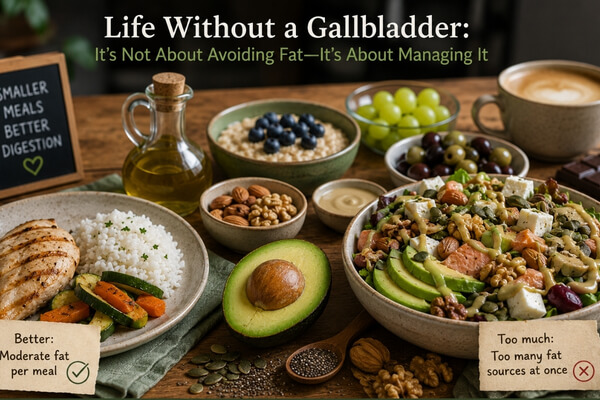
Fat Digestion After Gallbladder Surgery: Complete No Gallbladder Diet Guide
The question almost everyone asks after gallbladder removal is some version of: how am I supposed to digest fat without a gallbladder?
It's a reasonable fear, and the answer is more reassuring than most people are told — but also more complicated than "avoid fat."
What Actually Changed in Your Digestive Wellness
Your liver makes bile. It always did. The gallbladder was a storage tank: it held bile between meals, concentrated it, and released a large dose when food entered the small intestine.
After surgery, the liver continues to produce bile. It just drains into the intestine more or less continuously instead of arriving in a concentrated burst on demand.
So the system still works. What changed is timing and concentration, not capability. Bile acids still break large fat droplets into smaller ones so enzymes can reach them. That's why most people don't need a permanently fat-free diet, and why many eventually eat close to how they did before.
What you've lost is the reserve. For an ordinary meal, the steady trickle is fine. For a very fatty one, the demand can briefly outrun what's available.
Which produces the pattern people find so confusing: a teaspoon (approx. 5ml) of olive oil is fine, a modest portion of salmon is fine, half an avocado is fine — and then fried chicken with fries, a creamy sauce, and dessert is a disaster.
The Rule for Fat Digestion After Gallbladder Surgery: Fat Per Meal, Not Per Day
This is the single most useful reframe, and almost nobody is given it.
People ask can I eat eggs? can I eat avocado? can I use olive oil? The more useful question is how much fat can I comfortably handle in one sitting? Smaller amounts of fat are generally easier to manage after gallbladder removal; larger amounts are more likely to cause gas, bloating, and diarrhea (diarrhoea).
Compare two meals:
Meal A: baked cod, rice, cooked zucchini (courgette), a teaspoon of olive oil. Meal B: salmon, avocado, cheese, nuts, an oil-heavy dressing, chocolate dessert.
Every ingredient in Meal B is nutritious. It's also five concentrated fat sources in one sitting.
Which is why "healthy fat" can still cause symptoms. Olive oil, nuts, seeds, avocado, tahini, nut butter, and oily fish are all genuinely good foods. Your digestive system does not evaluate them by reputation. A smoothie with avocado, peanut butter, chia, and full-fat coconut milk is a high-fat meal regardless of how it photographs.
And it's why a salad can be harder work than a sandwich. A large "superfood" salad with half an avocado, cheese, walnuts, seeds, olives, salmon, and several tablespoons of dressing can carry more fat than a modest turkey sandwich. When symptoms hit, look at the whole plate rather than hunting for the one bad ingredient.
The fix is distribution, not elimination: ground flax on your oatmeal at breakfast, avocado at lunch, fish at dinner — rather than every fat source you own on one plate.
Three Practical Adjustments for a No Gallbladder Diet
Eat smaller, more often — at least while symptoms are active. If bile is arriving steadily rather than on demand, it makes sense that spreading food across three moderate meals plus a snack mixes better with what's available than two enormous ones. According to broad digestive wellness guidelines from the US National Institute of Diabetes and Digestive and Kidney Diseases (NIDDK) and the UK's National Health Service (NHS), this is standard advice for no gallbladder diet adaptation and managing post-cholecystectomy diarrhea (diarrhoea). It isn't a permanent rule, and it doesn't mean eating every two hours forever.
Look at the cooking method before you blame the food. People say "chicken gives me diarrhea now" and then tolerate baked chicken perfectly well. Fried chicken is chicken plus skin plus breading plus absorbed oil — a completely different fat load wearing the same name. Same for baked potato versus fries, grilled versus battered fish, steamed vegetables versus vegetables in butter.
Add complex fiber (fibre) gradually. Soluble fiber (fibre) naturally supports digestive wellness — oats and barley are the usual starting points, with fruits, vegetables, beans, chia, and psyllium as tolerance allows. But going from a low-fiber diet to bran, beans, lentils, raw vegetables, and chia overnight will produce gas and cramping, and you'll wrongly conclude fiber doesn't work for you. Start with oatmeal. Add cooked vegetables. Then build.
Finding your own threshold
Instead of asking whether you can eat fat, find out how much.
Start from a simple meal — rice, chicken breast, cooked zucchini (courgette). Add one modest fat source, like a teaspoon of olive oil, and notice what happens. On another day, try a different single source: some avocado, a few nuts, salmon, a spoon of nut butter.
The point is to test one thing at a time. What you're looking for is a threshold rather than a verdict — discovering that one tablespoon of nut butter is fine while three tablespoons plus avocado plus nuts is not, is far more useful than deciding you "can't digest peanut butter."
If your diet is already narrow or you're losing weight, navigate this with a nutritional professional rather than alone.
When It Isn't the Fat: Post-Cholecystectomy Diarrhea
Here's the part that changes what people do, and it's why this article shouldn't be read as a diet plan.
After gallbladder removal, diarrhea isn't necessarily poor fat digestion at all. Normally most bile acids are reabsorbed in the small intestine and recycled. When continuous bile flow disrupts that circulation, excess bile acids can reach the colon — where they stimulate secretion of water and electrolytes and speed things up. The result is watery stool, urgency, several bowel movements after eating, cramping, and the specific misery of not reliably making it to a bathroom.
So"I ate fat and couldn't digest it"is often the wrong explanation for the right symptoms.
How common is this? A systematic review pooling 3,476 patients found post-cholecystectomy diarrhea in 13.3% overall — 462 people — though individual studies ranged from 2.1% to 57.2% depending on how they defined and measured it. Most people don't develop chronic problems, and early loose stools often settle on their own.
But among those who do have persistent watery diarrhea, bile acid diarrhea is the leading explanation. The authors of that review concluded plainly that patients with suspected post-cholecystectomy diarrhea should be investigated early for it.
It is routinely mistaken for IBS. The symptom picture — urgency, frequency, watery stool, cramping after meals — looks almost identical to diarrhea-predominant IBS. Roughly a third of people with diarrhea-predominant or mixed IBS are estimated to have bile acid diarrhea without knowing.
How it's diagnosed depends heavily on where you live. SeHCAT is the established test, but it is not available in the United States and in many other countries, and worldwide the isotope is manufactured in a single facility. Where SeHCAT isn't available, clinicians use serum C4 (7α-hydroxy-4-cholesten-3-one), FGF19, or fecal bile acid measurement — or they skip testing and trial the treatment.
Guidelines genuinely disagree here. The Canadian Association of Gastroenterology suggests testing rather than an empiric drug trial; AGA guidance supports an empirical management trial as a practical alternative. Either route is defensible, and in the US the trial is often what actually happens.
To manage bile acids effectively, broad clinical frameworks generally involve bile acid sequestrants, which bind excess bile acids in the gastrointestinal tract. Cholestyramine is usually first, and here's the detail worth knowing before you start it: it's a resin powder that many people find genuinely unpleasant, and poor tolerability is the most common reason people quit. Colesevelam comes in tablet form and is often better tolerated.
Most importantly: in one study, 47% of people who failed on cholestyramine responded to colesevelam. Failing or abandoning cholestyramine does not rule out bile acid diarrhea. If you tried it, couldn't stand it, and gave up — that isn't a negative result, and it's worth going back.
These are prescription medications requiring supervision. They can interfere with absorption of other drugs, need careful timing, and may affect fat-soluble vitamin absorption over the long term.
When it isn't fat or bile acids
If you eat rice, baked chicken, and carrots with almost no added fat and still get urgent watery diarrhea, fat is not a convincing culprit.
A systematic review of long-term post-cholecystectomy symptoms found the causes are genuinely varied: coexisting digestive diseases (reported prevalence 1–65% across studies), retained or newly formed gallstones (0.2–23%), sphincter of Oddi dysfunction (3–40%), surgical complications (1–3%), and physiological changes from the surgery itself (16–58%).
The practical implication is the one I'd most want you to take away: at this point, cutting more fat is unlikely to be the answer. You probably need a structural evaluation rather than a stricter menu.
Your tolerance will probably change
What you can eat in week two doesn't predict what you can eat in month six. For most people, sensitivity is worst in the weeks after surgery and eases as the biliary system adapts.
Which means a food that caused problems early is worth retrying later, in a smaller portion. Avocado causing urgency in week two doesn't make avocado permanently off-limits in year five. People re-test far too rarely, and quietly carry restrictions for decades on the basis of one bad evening.
When to Consult a Healthcare Professional
Get medical advice if diarrhea persists rather than gradually improving, becomes severe, occurs after nearly every meal, causes dehydration, or is accompanied by weakness or unintended weight loss.
Seek prompt attention for severe or worsening abdominal pain, fever, jaundice, persistent vomiting, blood in the stool, very pale stools, or dark urine. None of those should be attributed to fat intolerance.
The Bottom Line for Managing Bile Acids
Gallbladder removal changes fat digestion. It doesn't switch it off. Your liver still makes bile; it simply arrives steadily rather than in a concentrated dose.
Most people adapt. For those who don't, what usually helps is smaller meals, avoiding large fat loads in one sitting, easing off fried food while symptoms are active, spreading good fats across the day, building fiber gradually, and testing foods instead of banning them.
And if watery diarrhea is still ruling your life, don't accept "that's just what happens without a gallbladder." It may be bile acids reaching the colon — which can be investigated, and often managed. Living without a gallbladder rarely means living without fat. It means learning how your system handles it now.
References
Farrugia A, et al. Postcholecystectomy diarrhoea rate and predictive factors: a systematic review of the literature. World Journal of Surgery. 2022;46(4):863–872.
Farrugia A, et al. Rates of Bile Acid Diarrhoea After Cholecystectomy: A Multicentre Audit. World Journal of Surgery. 2021;45(8):2447–2453.
Ruiz-Campos L, et al. Systematic review with meta-analysis: the prevalence of bile acid malabsorption and response to colestyramine in patients with chronic watery diarrhoea and previous cholecystectomy. Alimentary Pharmacology & Therapeutics. 2019;49(3):242–250.
Latenstein CSS, et al. Etiologies of Long-Term Postcholecystectomy Symptoms: A Systematic Review. Gastroenterology Research and Practice. 2019;2019:4278373.
Sadowski DC, et al. Canadian Association of Gastroenterology Clinical Practice Guideline on the Management of Bile Acid Diarrhea. Clinical Gastroenterology and Hepatology. 2020;18(1):24–41.
Camilleri M. Bile Acid Diarrhea: Prevalence, Pathogenesis, and Therapy. Gut and Liver. 2015.
Vijayvargiya P, Camilleri M. The Role of Bile Acids in Chronic Diarrhea. American Journal of Gastroenterology. 2020.
Mayo Clinic. Gallbladder removal: Diet and recovery guidance.
Custom HTML/CSS/JavaScript