Best Air Fryer Meals for MASLD Support
If you've been diagnosed with fatty liver disease — now more precisely called MASLD, or metabolic dysfunction-associated steatotic liver disease — you've probably heard some version of the same advice on repeat: manage your weight, eat healthier, move more. It's not exciting advice, but it's the advice that actually works.
(If you are just looking for a quick evening bite, skip to our guide on Late-Night Air Fryer Snacks to Support Your Liver).
So where does an air fryer fit into all this?
An air fryer isn't a clinical intervention. It won't artificially manipulate your liver enzymes or independently manage liver fat on its own, no matter what a product listing might imply. What it can do is make the eating pattern experts actually recommend for MASLD — more vegetables, more lean protein, less fried and processed food — a lot easier to stick with on a Tuesday night when you're tired and don't feel like cooking. The appliance isn't a clinical intervention. The habits it makes easier are.
How to Manage MASLD Naturally: Foundational Support
Lifestyle change remains, by a wide margin, the most effective wellness strategy for MASLD. According to nutritional frameworks supported by the US NIDDK and the UK's NHS, the research on this is fairly consistent:
Managing weight by just 3–5% can measurably help manage liver fat.
Managing weight by 7–10% may go further, supporting reduced liver inflammation and promoting overall tissue resilience.
Regular physical activity supports liver fat management even when weight changes are modest — movement itself seems to matter, not just the number on the scale.
A Mediterranean-style eating pattern is consistently the most recommended diet for MASLD, more so than any single "quick-fix" food.
There isn't one single liver-supporting food. Progress comes from consistently eating nutrient-dense meals that support a healthy weight, daily movement, and sustainable liver wellness over months and years, not from any single ingredient.
What's Changed Recently in MASLD Care
A few developments are worth knowing about if you want to manage MASLD naturally right now:
The name itself changed. What used to be called nonalcoholic fatty liver disease (NAFLD) was renamed MASLD to better reflect its link to metabolic conditions like obesity, type 2 diabetes, and high blood pressure — the disease is now understood as a metabolic condition that happens to show up in the liver, not just a liver problem in isolation.
There's now a drug for it — but only for the more advanced stage. In 2024, the US FDA (with similar monitoring by global bodies like the UK's MHRA) granted accelerated approval to resmetirom (brand name Rezdiffra), the first medication approved specifically for MASH (the more advanced, inflamed stage of the disease) with moderate to advanced fibrosis. It's meant to be used alongside diet and exercise, not instead of them, and it's specifically for people who've progressed to MASH with real scarring — not a targeted intervention for milder fatty liver. Following its approval, the GLP-1 medication semaglutide has also entered the MASH management space, while several other pipeline molecules continue through late-stage clinical trials.
Coffee continues to look good for the liver. Multiple studies — including recent cohort research from Italy — have linked regular coffee consumption to a meaningfully lower risk of liver fibrosis in people with MASLD, likely due to coffee's effects on insulin resistance. If you already drink coffee, this is one habit you probably don't need to give up, especially when it is part of a broader routine of liver-supporting hydration habits.
Ultra-processed foods are getting more attention as a risk factor in their own right, separate from calories or weight. Newer research suggests that a diet heavy in ultra-processed foods is associated with worse MASLD outcomes even after accounting for body weight, which is part of why "eat whole foods" keeps coming up as core advice, rather than just "eat less."
None of this changes the fundamentals. But it does mean the advice has gotten a bit more precise and a bit more hopeful over the past couple of years.
Why Air Fryers Can Support Dietary Changes
Air fryers work by circulating very hot air around food, which produces a crispy, satisfying texture with little or no added oil. For someone trying to eat differently for MASLD, that matters more than it might seem — a lot of healthy eating advice fails not because people don't understand it, but because the food that results feels like a punishment. An air fryer can help close that gap.
Practically, an air fryer makes it easier to:
Cut calories from added fats without cutting flavor (flavour)
Prepare vegetables often enough that they become a default, not an afterthought
Cook lean proteins quickly on a weeknight
Swap out deep-fried foods for a lighter version of the same craving
Make meals at home more often instead of reaching for takeout
None of these changes is dramatic. But they compound — a few fewer fried takeout meals a month, a few more vegetable-heavy dinners at home — into exactly the kind of pattern that's linked to improvement in liver fat over time.
The Best Fatty Liver Air Fryer Foods for Daily Wellness
The healthiest air fryer meals are built around whole fatty liver air fryer foods, not the pre-packaged "air fryer" snacks lining grocery store freezers.
Lean Protein Sources
Protein helps preserve muscle mass during weight management and keeps you fuller for longer, which matters a lot if part of your plan involves eating somewhat less overall.
Chicken breast
Turkey breast
White fish (cod, tilapia, haddock)
Salmon
Shrimp
Tofu
Tempeh
Non-Starchy Vegetables
Vegetables provide fiber (fibre), vitamins, minerals, and antioxidants with little in the way of calories, and the air fryer makes them genuinely craveable rather than something to push around your plate.
Broccoli
Cauliflower
Brussels sprouts
Zucchini (courgette)
Bell peppers (sweet peppers)
Green beans
Asparagus
Mushrooms
Fiber-Rich (Fibre-Rich) Carbohydrates
Fiber (fibre) supports fullness and helps regulate blood sugar, which is relevant given how closely MASLD is linked to insulin resistance.
Sweet potatoes
Chickpeas
Lentils
Beans
Small portions of regular potatoes
Together, these three categories map closely onto a Mediterranean-style eating pattern—making a Mediterranean diet air fryer routine the approach most consistently recommended for people managing MASLD, and the one with the strongest evidence behind it.
Air Fryer Foods That Aren't Liver-Friendly
Not everything that comes out of an air fryer is automatically a healthy choice. Some foods stay high in calories, sodium, saturated fat, or refined carbohydrates no matter how they're cooked — the appliance changes the texture, not the nutrition label. Try to limit:
Breaded frozen foods
Processed chicken nuggets and tenders
Sausages and other processed meats
Sugary glazes and sticky coatings
Packaged snack foods marketed specifically for air fryers
Large portions of fries (chips), even "healthier" ones
Think of the air fryer as a tool for cooking whole foods well, not a new delivery method for ultra-processed ones. The appliance doesn't discriminate between a sweet potato and a bag of frozen mozzarella sticks — that part is still up to you.
5 Easy Air Fryer Meals for Fatty Liver: MASLD Support
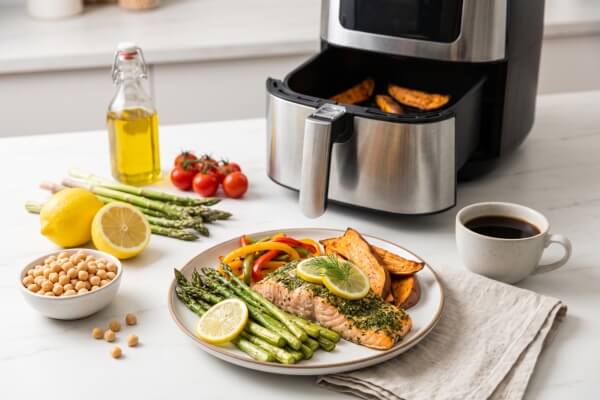
1. Mediterranean Salmon and Asparagus
Salmon delivers omega-3 fats, while asparagus adds fiber and nutrients. Finish with lemon juice, garlic, and fresh herbs for an easy weeknight dinner that comes together in under 20 minutes.
2. Garlic Herb Chicken with Roasted Vegetables
Air-fried chicken breast paired with broccoli, zucchini (courgette), and bell peppers (sweet peppers) makes a balanced, protein-rich meal that reheats well for lunch the next day.
3. Crispy Chickpea Bowl
Air-fried chickpeas (toss with a little olive oil, cumin, and paprika before cooking) over greens with cucumber, tomatoes, and a light olive oil dressing. A satisfying plant-based option with plenty of fiber.
4. Turkey Meatballs with Vegetables
Lean turkey meatballs alongside roasted Brussels sprouts and cauliflower — filling, protein-rich, and easy to make in a big batch for the week.
5. Sweet Potato Wedges and Fish
A lighter take on traditional fish and chips (french fries) that still delivers fiber (fibre), protein, and the satisfying crunch you're actually craving.
What People Who Successfully Manage Fatty Liver Often Have in Common
Individual results vary quite a bit, but people who report meaningful improvement in their MASLD tend to describe a similar handful of habits:
Following a Mediterranean-style diet, more or less consistently
Cutting back on ultra-processed and packaged foods
Reducing added sugars, particularly sugary drinks
Exercising consistently, even if it's just regular walking
Managing body weight gradually, rather than through crash dieting
These patterns show up again and again in both clinical research and in the accounts of people actually living with the condition, proving it is practical to manage MASLD naturally—and none of them depend on a single food or gadget.
The Bottom Line
Air fryer meals can absolutely support a fatty-liver-friendly lifestyle — but only when they're built around nutritious ingredients rather than reheated processed food. The appliance itself doesn't directly manage liver fat. What matters is using it to prepare the foods research consistently links to better liver wellness: vegetables, lean proteins, legumes, fish, and other minimally processed ingredients.
Paired with regular exercise, gradual weight management, and supporting total-body balance, and a Mediterranean-style eating pattern — and, for some people with more advanced disease, newer management options now available alongside lifestyle changes — an air fryer can make those changes easier to sustain for the long haul.
Need help putting these habits into practice? Take the guesswork out of your weeknight dinners with targeted MASLD diet recipes designed for your specific metabolic needs: