MASLD Nutrition: Protein & Fatty Liver Guide
Protein has become one of the most confused nutrients in fatty liver nutrition.
Some people are told to eat more to lose weight and protect muscle. Others hear that "protein is hard on the liver." Then there are high-protein shakes, meat-heavy diets, plant-based protein plans, and claims that protein can somehow burn liver fat directly.
Here's where the evidence actually lands — including the mechanism that explains why what you eat your protein from matters more than the number of grams you chase.
What your liver is doing with protein right now
When you eat protein, your digestive system breaks it down into amino acids. Those amino acids build and repair muscle, make enzymes, produce hormones, support immune function. They also contain nitrogen.
When amino acids get broken down for energy, that nitrogen becomes ammonia — toxic at high concentrations. Your liver runs the urea cycle to convert ammonia into urea, which the kidneys then excrete.
So yes: more protein means more amino acid metabolism, and the liver handles that work. Processing nutrients is one of its normal jobs. A normal increase in dietary protein doesn't damage a healthy liver, any more than walking further damages healthy knees.
Does more protein make fatty liver worse?
In controlled trials, often the opposite.
A randomized trial comparing a hypocaloric high-protein, low-glycemic diet with a conventional calorie-restricted diet in people with metabolic fatty liver disease found the high-protein group had greater reductions in body weight and liver fat at 12 weeks. Other small trials using both plant and animal protein have found similar reductions.
A 2026 systematic review of high-protein diets and MASLD concluded that they exert dual effects — beneficial and potentially unfavorable — depending primarily on protein source and amount.
Which is the honest answer: more protein is not automatically better, and the source matters more than most protein advice acknowledges.
Where protein genuinely helps: protecting muscle during weight loss
This is the primary reason protein matters in MASLD management, focusing on supporting natural metabolic wellness and preserving lean tissue during gradual weight reduction.
For people with MASLD and obesity, gradual weight reduction substantially reduces liver fat and, with larger sustained losses, may improve inflammation and fibrosis. But when calories drop, some of the weight lost comes from muscle rather than fat — particularly without adequate protein and without resistance training.
That matters because skeletal muscle is where most glucose gets disposed of after a meal. It's the largest energy sink in your body. Lose muscle during weight loss and you've weakened the system that handles blood glucose, reduced your insulin sensitivity, and made long-term weight maintenance harder.
Broad digestive wellness guidelines from the European Association for the Study of the Liver (EASL), alongside the US American Association for the Study of Liver Diseases (AASLD) and the UK's National Health Service (NHS), emphasize sufficient protein and physical activity to support natural body balance during weight management — including and especially in people with advanced liver disease, where sarcopenia is itself a serious clinical complication.
A 2025 meta-analysis of resistance training in MASLD pooled 11 randomized trials in 395 participants: ALT fell significantly, and 7 of 8 imaging studies showed meaningful reductions in liver fat content. That's a cleaner result than many dietary supplements produce in far larger trials. Protein without resistance training works poorly; resistance training without protein works poorly. Together they preserve what matters while the weight comes down.
The mechanism nobody explains: where red meat becomes a liver problem
Every article on protein and fatty liver says something like "plant protein has a more favorable metabolic profile than red meat." Almost none of them explain why — which is a shame, because the reason is specific, interesting, and changes what you might actually do about it.
The answer runs through your gut bacteria.
L-carnitine — abundant in red meat — and choline are broken down by certain gut bacteria into trimethylamine (TMA). That TMA gets absorbed through the gut wall and travels to the liver via the portal vein, where the liver converts it into trimethylamine N-oxide, or TMAO.
TMAO has been linked to several mechanisms that promote fatty liver and cardiovascular disease: disrupting bile acid metabolism, triggering oxidative stress, activating endoplasmic reticulum stress pathways that promote fat accumulation in liver cells.
The important nuance: this pathway runs through gut bacteria, not directly through the food. A 2018 controlled dietary intervention in 113 people found that chronic red meat consumption significantly raised TMAO levels compared with white meat or plant protein, even on isocaloric diets. But individual responses vary considerably depending on gut microbiota composition — people with metabolic syndrome produce more TMAO in response to the same food than those without. One recent trial found that subjects with metabolic syndrome had substantially different TMAO responses to eggs and meat than metabolically healthy subjects eating identical meals.
Two honest caveats: most human TMAO research is observational, and causation remains contested — TMAO may partly be a marker of dietary pattern rather than a direct cause of disease. Fish also contains preformed TMAO and still appears protective in MASLD research, suggesting the pathway is more nuanced than "TMAO = bad." The research is ongoing. But the gut-liver-protein link is real, and it's the specific mechanism behind the consistent finding that processed red meat is worse for MASLD than plant protein — over and above its saturated fat content.
What it means practically: lean red meat produces less saturated fat than fatty cuts, but it still generates TMAO. Plant proteins don't meaningfully feed the TMAO pathway. This is a separate reason — additional to saturated fat and calories — why the protein source matters.
The source question in plain terms
Compare two ways to add protein:
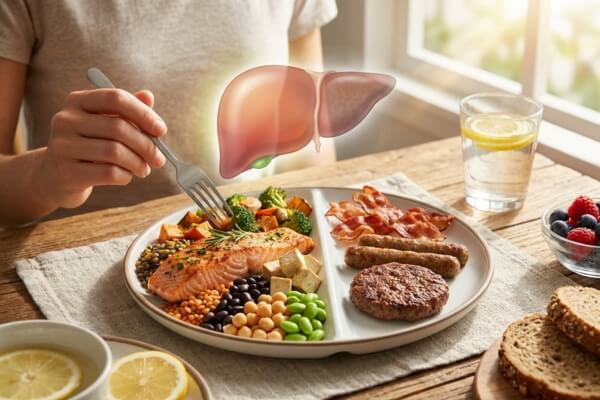
Path A: more bacon, sausage, burgers, processed deli meat, fatty red meat.
Path B: more lentils, beans, chickpeas, tofu, tempeh, edamame, fish, plain yogurt (yoghurt), modest portions of lean poultry.
Both deliver more protein. They are not equivalent in the liver, and now you know one specific reason why.
The 2024 EASL–EASD–EASO guidelines recommend a Mediterranean-style pattern rich in vegetables, fruits, legumes, whole grains, fish, and seafood while reducing red and processed meat. That recommendation reflects both the saturated fat evidence and the emerging TMAO research.
None of this requires eliminating animal protein. It means asking where the extra protein is coming from rather than only how many grams.
Plant protein brings more than protein
A bowl of lentils isn't just protein. It also provides complex fiber (fibre), complex carbohydrates, potassium, folate, and phytochemicals. Replacing fatty processed meat with lentils or tofu simultaneously increases fiber (fibre), reduces saturated fat, and shifts the TMAO-generating substrate away from the liver.
That's why shifts toward plant protein tend to improve the whole diet rather than just adding a nutrient. To establish a sustainable daily routine, explore our comprehensive MASLD nutrition guide for practical meal strategies.
Simple examples:
Sausage and white toast → tofu scramble and whole-grain toast
Processed meat sandwich → chickpea or tuna with vegetables
Large beef burger → lentil-bean patty, or smaller lean protein with beans and vegetables
You don't have to remove animal protein. Shifting some of it toward plants produces compounding benefits across multiple mechanisms at once.
Fish: the useful exception
Fish sits in a complicated position in the TMAO story — it contains preformed TMAO, yet Mediterranean dietary research consistently shows it supports liver health. The current reading is that the omega-3 fatty acids in oily fish, and the protein quality in white fish, outweigh whatever TMAO contribution comes from eating it.
Practically: baked salmon with vegetables and barley, white fish baked with herbs, sardines on whole-grain toast. Preparation remains relevant — the meal containing the fish matters as much as the fish itself.
Can you eat too much protein?
Yes, and the threshold isn't fixed — it moves with body size, age, activity, kidney function, muscle mass, cirrhosis stage, and whether you're in active weight loss.
Major MASLD guidelines don't give a universal high-protein target for uncomplicated fatty liver. Advice centers on overall diet quality, energy balance, and cardiometabolic risk rather than one number.
Beyond an adequate intake, adding dramatically more doesn't guarantee additional benefit. Protein still contributes calories. Two protein shakes, several protein bars, and extra meat on top of an already sufficient diet raise total energy intake — and for fatty liver, extra calories don't become harmless just because they came from protein.
Protein powder: tool, not treatment
A shake can help when appetite is low, breakfast is rushed, or muscle preservation is a specific concern. It has no special ability to remove fat from the liver.
Many products also carry added sugars, coconut-based fats, artificial sweeteners, and proprietary herbal blends that complicate the picture. For most people, ordinary food provides enough protein without those additions.
If you use a supplement: treat it as convenience, check the label, and don't let it crowd out the legumes, fish, and yogurt doing the more interesting work.
The cirrhosis exception — and why it matters
For a long time, people with advanced liver disease were told to restrict protein because protein metabolism produces ammonia. That advice caused serious harm.
People with cirrhosis are often at significant risk of malnutrition and muscle loss, and severe sarcopenia makes advanced liver disease harder to manage. Muscle helps handle ammonia outside the liver, which is why losing it makes encephalopathy risk worse, not better.
Current European guidance recommends higher protein — around 1.2–1.5 grams per kilogram per day — in people with sarcopenia, sarcopenic obesity, or decompensated MASH-related cirrhosis. AASLD states that protein should not routinely be restricted even in hepatic encephalopathy.
If you have cirrhosis and someone tells you to eat very little protein based on something you read in a forum: this is one case where individualized clinical guidance genuinely outweighs general internet advice.
The kidney complication
For people managing both MASLD and chronic kidney disease, "eat more protein for your liver" can conflict directly with "moderate protein to protect your kidneys." The US National Institute of Diabetes and Digestive and Kidney Diseases (NIDDK) and the UK's National Institute for Health and Care Excellence (NICE) emphasize individualized targets for CKD, and the two diagnoses don't resolve neatly.
This is the clearest example in this space of why treating one number — protein grams — without accounting for the full clinical picture produces advice that's correct for one diagnosis and wrong for the other.
The mistake worth naming
Someone reads that protein helps fatty liver. Breakfast shifts from oatmeal, berries, and yogurt to bacon, eggs, and cheese. Lunch doubles the meat. Dinner becomes a large steak.
Protein intake went up. So did saturated fat, red and processed meat, and TMAO-generating substrate. Meanwhile, fiber dropped, legumes disappeared, whole grains disappeared, and fruit became less prominent.
The diet moved away from the Mediterranean pattern guidelines recommend, toward the dietary pattern associated with metabolic syndrome. Technically, the protein target improved. Actually, everything else got worse.
Protein should improve the structure of a diet, not take it over.
The bottom line
When you eat more protein, your liver processes the resulting amino acids and converts nitrogen-derived ammonia into urea. For people with MASLD, increasing protein within a balanced diet can help — by improving meal satisfaction, supporting weight loss, preserving muscle, and replacing less favorable foods when the protein comes from legumes, soy, fish, and other minimally processed sources.
The evidence on liver fat reduction from high-protein diets is real but modest, and the benefits are hard to separate from overall calorie reduction and diet improvement.
The more useful question is never "how much protein can I eat?" It's "where is it coming from?" Red and processed meat generate TMAO through the gut bacteria, a distinct pathway from saturated fat that adds an additional reason source matters. Plant protein doesn't. Fish appears protective despite its TMAO content, probably because of omega-3 fats.
For fatty liver, the protein source distinction matters more than the number on the label.
References
Tacke F, et al. EASL–EASD–EASO Clinical Practice Guidelines on the management of MASLD. Journal of Hepatology. 2024;81(3):492–542.
AASLD Practice Guidance on the clinical assessment and management of NAFLD. Hepatology. 2023;77:1797–1835.
High-protein diets and metabolic dysfunction-associated steatotic liver disease: A double-edged sword in liver health. World Journal of Gastroenterology. 2026. PMID: 41695277.
Bischoff SC, et al. ESPEN practical guideline: Clinical nutrition in liver disease. Clinical Nutrition. 2020.
Resistance training for metabolic dysfunction-associated steatotic liver disease: a systematic review and meta-analysis. Frontiers in Endocrinology. 2025. PMC12907158.
Koeth RA, et al. Impact of chronic dietary red meat, white meat, or non-meat protein on trimethylamine N-oxide metabolism and renal excretion in healthy men and women. European Heart Journal. 2019;40(7):583–594.
Trimethylamine N-oxide induces non-alcoholic fatty liver disease by activating the PERK pathway. Toxicology and Applied Pharmacology. 2024.
Plasma and Urinary TMAO and Methylamine Responses to Meat and Egg Ingestion: Links to Gut Microbiota Composition in Subjects With and Without Metabolic Syndrome. Nutrients. 2025. PMC12693793.
National Institute of Diabetes and Digestive and Kidney Diseases. Eating, Diet, & Nutrition for NAFLD & NASH.
Custom HTML/CSS/JavaScript