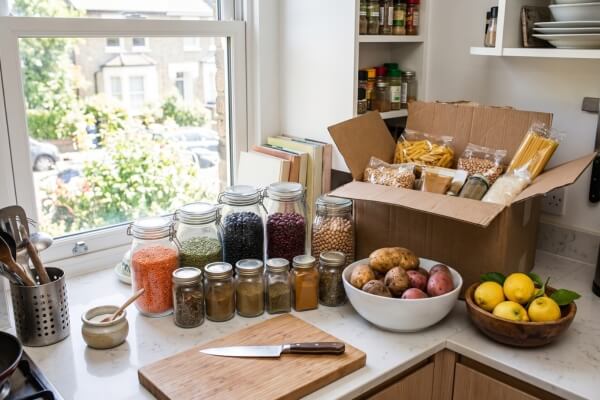
Ingredient Substitutes: A Guide to Healthy Cooking in a Small Town
My town has one supermarket. It shuts at six, closes entirely on Sundays, and has never once stocked tahini.
I develop recipes for a living.
That combination sounds like a problem, and for a while I treated it as one — a logistics failure standing between me and proper cooking. It took me an embarrassingly long time to notice that my pantry had quietly become better than it was when I lived somewhere with three specialty shops within walking distance.
I live in a small town in the heart of Europe, by choice. I like the pace, the size, the fact that I know the person who sells me bread. What I don't have is a forty-foot international aisle. Some ingredients are never stocked. Some appear for three weeks and vanish for six months. Some require visiting three shops, one of which closes Wednesdays for reasons nobody has ever explained to me.
So when readers tell me they are struggling with hard to find ingredients in a recipe, I'm not sympathizing from a distance. I'm standing in the same aisle.
And here's what I've learned there: an ingredient being unavailable locally doesn't make it exotic, expensive, or difficult. It makes it unstocked. Those are entirely different problems, and only one of them is actually yours.
The Three Core Moves for Missing Ingredients
Whenever something isn't on the shelf, there are only three options, and I use all of them constantly.
Move One: Substitute Smartly
This handles most cases, and it works better once you stop thinking about ingredients by name and start asking what is this doing in the recipe?
A reliable tahini substitute adds fat, mild bitterness, and the ability to make a dressing creamy without dairy, which is a staple approach when using dairy-free alternatives. Sunflower seed butter does the same job and is often easier to find. In hummus, olive oil plus extra lemon gets you most of the way.
Worth knowing: sesame became the ninth major US allergen under the FASTER Act, with labeling required since January 2023 and over 1.5 million Americans affected. So the sunflower swap isn't only about availability.
A good nutritional yeast substitute mimics its savory, faintly cheesy seasoning profile. Grated parmesan covers it if dairy is fine; white miso plus a squeeze of lemon covers it if not.
One correction, because this one matters: nutritional yeast is widely assumed to be a B12 source. Only fortified versions contain B12— unfortified has none, and Harvard Health's dietitians advise against relying on it either way, since brand levels vary enormously. If you're plant-based, read the label and take a supplement.
Specialty grains— farro, freekeh, millet, sorghum — are about texture and variety, almost never structure. They substitute for each other freely. Pearl barley stands in for farro nearly perfectly and costs a third as much.
Lentils follow one rule worth memorizing: black and French green hold their shape, so they belong in salads and under things. Brown, red, and yellow break down, so they belong in soups and dals. Swap freely within each group; think twice about crossing between them.
White beans— cannellini, butter beans, great northern, navy — are close to interchangeable. Different sizes, same behavior.
Spice blends are mostly spices you already own. Za'atar is dried thyme, sesame, sumac, salt(lemon zest if there's no sumac). Baharat is black pepper, cumin, coriander, cinnamon, cloves, paprika. Everything bagel seasoning is sesame, poppy, dried garlic, dried onion, flaky salt.
The thing that actually flattens a dish is usually not a missing blend — it's a jar of cumin from 2019. Ground spices fade within about a year.
Low-sodium products you frequently don't need at all. Draining and rinsing canned beans removes a substantial share of the sodium, because it's in the liquid. Dilute regular stock with water and add acid at the end — lemon or vinegar makes food taste seasoned without salt.
And here's the part worth internalizing: more than 70% of dietary sodium in the US comes from packaged and restaurant food, not the salt shaker. Average intake runs about 3,400 mg a day, which exceeds both the FDA's recommended limit of 2,300 mg of sodium and the UK National Health Service (NHS) guideline of 6g of salt (roughly 2,400 mg of sodium) daily. If you're prioritizing low sodium cooking from basic ingredients (staples) rather than packages, you've already done the large intervention. The specific low-sodium product is a refinement.
Move Two: Order Strategically
Some things I do buy online, because local supply is unreliable rather than absent, and because a few of them genuinely have no substitute.
What earns a place on that list is narrow:
It keeps. Dried goods, spices, flours, nut butters, canned goods. If it perishes in a week, ordering makes no sense.
I use it repeatedly. Not once, for one recipe, because a magazine said to.
The substitute isn't good enough. Chickpea flour has no real stand-in. Ras el hanout and berbere are complex enough that approximating them is a compromise. Buckwheat matters if you need genuinely gluten-free.
What I order: chickpea flour, specific spice blends, certain dried beans and lentils, tahini when I find a brand I like, nutritional yeast, and occasional grains for variety rather than necessity.
Subscriptions are worth it for exactly one category — the things you use at a predictable rate and always want in the house. For me that's a short list, and the trap is signing up for enthusiasm rather than habit. A subscription for something you use monthly is a gift to yourself. A subscription for something you used once in a burst of ambition is a slowly accumulating shelf of regret.
Two practical notes. Buy two when you find something locally— pantry staples keep for months, and it removes the anxiety about whether it'll be there next week. And check the shipping threshold before you fill a cart, because the free-delivery minimum is how a €9 order becomes a €40 order.
Move Three: Skip It Entirely
This is the one people resist, and it's the most freeing.
If a recipe calls for a tablespoon of something you don't have, make the recipe anyway. It will usually be fine. Occasionally it'll be different, and also fine.
A recipe is instructions someone wrote for their own kitchen with their own shop down the road. It is not a contract. I've had readers postpone a dish for a month over one missing item — and the version they'd have made in week one would have been good.
Don't Be Intimidated by Unfamiliar Ingredients
I think part of what's happening in those comments isn't only availability. It's the sense that unfamiliar ingredients belong to people with more expertise, better shops, more time.
They don't. Tahini is ground sesame seeds. Nutritional yeast is deactivated yeast flakes. Freekeh is young wheat, roasted. Za'atar is a herb mix that has existed for centuries because it's good on bread. None of it requires technique, and most of it costs less than a jar of decent mustard.
If you want to try one, buy one. Use it in three things over a fortnight so it doesn't become a museum piece. Then decide.
What Actually Makes Food Nourishing
A meal isn't healthy because it contains one hard-to-find ingredient. It's healthy because of what you eat most weeks.
Most of what I cook contains nothing unusual at all: potatoes (jacket potatoes), oats, rice, beans, everyday vegetables like zucchini (courgette), fruit, eggs, and ordinary lean proteins. That list is available in essentially every grocery store on earth, and it's also — not coincidentally — the list underneath every dietary pattern associated with long-term vitality and daily wellness.
The specialty items rotate through and make things interesting. They're the supporting cast. They were never the reason it worked.
So: start with what's on the shelf, substitute when you need to, order a few favorites if you want to, and don't let one missing jar stop you cooking.
References
U.S. Food and Drug Administration. The FASTER Act: Sesame Is the Ninth Major Food Allergen.
Harvard Health Publishing. Nutritional yeast: Does this savory, vegan seasoning pack a nutritional punch? 2025.
U.S. Food and Drug Administration. Sodium Reduction in the Food Supply. Voluntary Sodium Reduction Goals, Edition 2 (draft guidance, August 2024).
Dietary Guidelines for Americans, 2020–2025.
Custom HTML/CSS/JavaScript