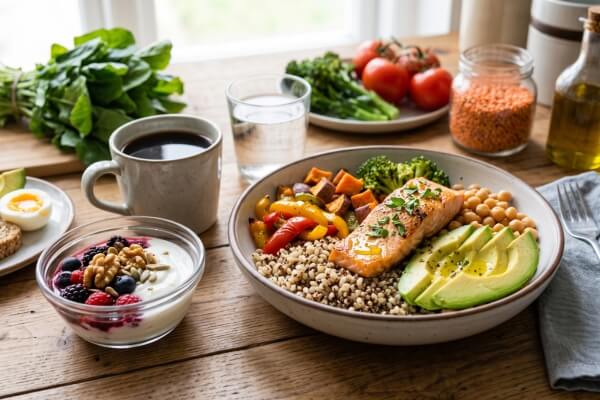
7 Essential Additions for a Fatty Liver Diet
General information, not medical advice. People with advanced fibrosis, cirrhosis, sarcopenia, malnutrition, or kidney disease need individualized guidance rather than general advice. Talk to your doctor or a registered dietitian.
Almost everything written about eating for a fatty liver diet is about subtraction. Cut the sugar. Cut the fried food. Cut the alcohol. Cut the processed food.
That advice isn’t wrong, and if you haven’t done it, do it. But it produces a strange failure mode: people arrive at a diet that is impeccably free of bad things and still not a good diet. Everything has been removed. Not much has been added.
This article is about the other direction — what’s absent from a fatty liver diet that looks perfectly clean. Every item below is something to put in.
None of which replaces the subtraction. Sugary drinks, excess saturated fat, ultra-processed food, and alcohol all matter, and if any of those are still routine, start there. This is the half that comes after.
1. Carbohydrate quality, not just less fat
For twenty years, liver-friendly eating got compressed into one instruction: eat less fat. Follow it literally and you end up eating white bread, crackers, pretzels, low-fat cookies, sweetened cereal, and white rice.
Barely any fat. Also barely any of what the guidelines actually ask for. The American Association for the Study of Liver Diseases (AASLD), alongside the UK's National Health Service (NHS), notes that excess calories — particularly from saturated fat, refined carbohydrates, and sugary drinks — are associated with fatty liver, and the US National Institute of Diabetes and Digestive and Kidney Diseases (NIDDK) recommends more low-glycemic foods rather than simply less fat.
A plate of beans, barley, vegetables, and a spoonful of olive oil contains more fat than fat-free crackers. It’s also much closer to the recommended pattern.
Put in: oats, barley, beans, lentils, whole grains, starchy vegetables, whole fruit. The target isn’t fewer carbohydrates — it’s better ones.
2. Fiber (Fibre), Because Your Liver is Downstream of Your Gut
Look at yesterday. How many meals contained vegetables, whole fruit, beans, whole grains, nuts, or seeds? If the answer is close to none, your diet can be lower in calories and fat while missing the single most defining feature of a high-quality pattern.
There’s a specific reason fiber (fibre) matters here rather than generally. Your liver receives most of its blood supply directly from the intestine, through the portal vein — meaning it is the first organ exposed to whatever crosses the gut wall. Fermentable fiber (fibre) feeds the bacteria that maintain that wall and produces short-chain fatty acids that support it. A diet with almost no fiber (fibre) changes what arrives at the liver, not just what arrives at the colon.
AASLD encourages diets enriched with fiber (fibre) and unsaturated fats; European guidance, aligned with the British Liver Trust, describes Mediterranean-style eating built on vegetables, fruit, legumes, whole grains, nuts, seeds, olive oil, and fish.
Put in, gradually: oatmeal at breakfast. A vegetable at lunch. Beans or lentils a few times a week. Then barley, farro, brown rice. Going from almost none to enormous amounts overnight will make you feel dreadful and convince you fiber (fibre) doesn’t agree with you.
3. Protein — and the muscle it protects
Some people treat fatty liver as a reason to live on vegetables, soup, and small portions of grain. The scale drops. Not all of what’s leaving is fat.
This matters more than it sounds. Skeletal muscle is where most glucose gets disposed of after a meal — it’s the largest sink your body has for the energy that would otherwise be handled by the liver. Lose muscle while losing weight and you weaken the system you’re trying to support. Sarcopenia and MASLD are associated in both directions, and the combination of low muscle with excess fat is worse than either alone.
European nutrition guidance, aligned with the British Liver Trust, specifically emphasizes adequate protein during weight management in a fatty liver diet to limit muscle loss and support metabolic wellness.
A bowl of vegetables and rice isn’t complete because everything in it looks healthy. Beans or tofu change it substantially.
Put in: beans, lentils, tofu, tempeh, edamame, fish, plain yogurt (yoghurt), eggs, lean poultry — and resistance training, which is the other half of this and does nothing on its own if the protein isn’t there.
Important: there’s no single protein target for everyone. Requirements shift with body size, age, kidney function, activity, cirrhosis, and sarcopenia. Anyone with advanced liver or kidney disease needs individualized dietetic advice, not a high-protein plan from the internet.
4. Unsaturated fat, which is left with the saturated fat
"There’s fat in my liver, so I should stop eating fat" sounds logical and misreads how liver fat forms.
NIDDK recommends replacing saturated and trans fats with unsaturated fats. AASLD favors patterns enriched with unsaturated fat and fiber (fibre). The operative word is replacement — and in practice people perform the removal without the replacement, ending up with a diet low in saturated fat and low in everything else too.
Toast with butter and sausage becomes whole-grain toast with a modest amount of avocado and an egg. Cream-based pasta becomes whole-grain pasta with vegetables, beans, and a little olive oil.
Put in: olive oil, rapeseed or canola oil, nuts, seeds, avocado, oily fish — in place of butter, cream, processed meat, and large amounts of cheese, not stacked on top of them.
5. Choline — the one nobody mentions
Here’s a nutrient with a direct, well-characterized link to liver wellness that almost never appears in fatty liver diet advice.
Choline is required to build and export very-low-density lipoproteins — the vehicles that carry fat out of liver cells. Without enough of it, triglycerides accumulate inside the liver because there’s no way to ship them out. This isn’t extrapolated from mice: controlled human depletion studies put healthy adults on choline-deficient diets and watched liver enzymes rise within weeks, then normalize when choline was restored.
The adequate intake — 550 mg a day for men, 425 mg for women — was set specifically at the level needed to maintain liver wellness and support natural metabolic balance. That’s the endpoint the number was built around. And US survey data shows most adults consume well below it.
Now the honest part, because the population evidence is genuinely mixed. One case-control study found low choline intake associated with dramatically higher odds of steatosis in people with visceral obesity. But a 2024 analysis of nearly 5,700 US adults found total choline intake was not associated with MASLD prevalence at all — and among people who already had MASLD, higher intake was associated with higher odds of significant fibrosis.
Requirements also vary genetically: a common variant in the PEMT gene changes how much you need, with the effect differing between men and women.
So this isn’t a case for supplements, and nobody should be taking choline pills for their liver on the strength of the above.
It is a case for noticing where choline comes from: eggs, liver, fish, poultry, soybeans, and cruciferous vegetables. Which is worth noticing because a strict low-fat, low-cholesterol liver diet often removes eggs and cuts meat and fish — quietly deleting the main dietary sources of a nutrient whose deficiency challenges exactly the metabolic balance being managed. If your diet has been getting cleaner and narrower, this is a plausible gap.
6. Actual food, where the diet products are
A cupboard full of things labeled keto, low fat, sugar free, protein, low carb, or plant based can leave a diet technically compliant and nutritionally hollow.
The useful question isn’t whether the package makes a claim. It’s what is this replacing? A protein bar occasionally standing in for a chocolate bar is fine. Protein bars standing in for beans, oats, fruit, vegetables, and meals is a straight loss of everything in items 1 through 5.
Not every package is a problem — canned beans, frozen vegetables, whole-grain bread, plain yogurt (yoghurt), and canned fish are all excellent and practical. The issue is a diet assembled mostly from products engineered around a single removed nutrient.
7. A version of this you’d still be doing next year
This is the one that determines whether any of the above happens.
A plan can look ideal and be impossible: cook everything from scratch, never eat out, no carbohydrates, no fat, nothing sweet ever, weigh every ingredient, skip social meals. If you’re counting down to when it ends, it’s already failed, because your liver responds to what you do for years rather than weeks.
AASLD notes that several dietary approaches can support fatty liver wellness, and that recommendations should be adapted to cultural and personal preference to support long-term adherence. That’s not a soft concession — adherence is the mechanism.
Ask what you could still be doing next year. Beans a few times a week. Vegetables with two meals. Olive oil more often than butter. Fish regularly. Eggs back on the menu. Dessert made smaller rather than forbidden.
Progress that continues beats perfection that lasts twelve days.
The addition that isn’t food
Someone can spend enormous energy optimizing breakfast while barely moving all day.
Exercise supports metabolic health even when weight doesn’t change — AASLD emphasizes hepatic and metabolic benefits independent of weight loss. European guidance suggests preferably more than 150 minutes of moderate or 75 minutes of vigorous activity weekly, where appropriate.
And given item 3, resistance training earns particular attention here. Walking is good. Walking plus something that maintains muscle is better, because muscle is doing metabolic work for you between sessions.
You don’t need to do all seven
There’s a risk in an article like this: you read seven items and acquire seven anxieties.
No meal needs a perfect protein amount, five vegetables, whole grains, legumes, omega-3 fats, seeds, and choline simultaneously. Nutrition works across the pattern, not the plate. Breakfast might be oatmeal and fruit. Lunch might be lentils and vegetables. Dinner might be fish and potatoes. Tomorrow might look nothing like it.
Two things worth checking that aren’t on this list
Alcohol. “Metabolic” in the disease name doesn’t make it irrelevant — reducing alcohol is one of the lifestyle changes European guidelines name for MASLD management, and the thresholds that separate MASLD from MetALD are lower than most people assume. If nobody has asked you about your intake, raise it yourself. People with inflammation, fibrosis, or cirrhosis are often advised to stop entirely.
Medical Management. Since 2024, specific medications have been approved for MASH with moderate-to-advanced fibrosis. The US FDA and UK MHRA label these for use strictly alongside a supportive MASLD nutrition plan and exercise, targeting people with significant scarring. If your liver hasn’t responded despite real dietary change, it’s worth asking whether you’re a candidate.
A different kind of self-check
Most fatty liver checklists ask what you’ve removed. Try asking what’s arrived:
What did I add to my diet this month, rather than take away?
Do fiber-rich (fibre-rich) plant foods appear most days, or only in theory?
Does most of my food come with a protein source attached?
Did unsaturated fat come back in when saturated fat went out?
Am I still eating eggs, fish, or other choline sources — or did those quietly disappear?
How much of this week’s food was real food, rather than a packaged product?
Am I supporting muscle balance, or only losing weight?
Has anyone actually asked me about alcohol?
Could I still be doing this next year?
For practical daily application, explore our 5 Essential Fridge Staples for MASLD to keep your kitchen stocked for long-term liver wellness.
The Bottom Line
A fatty liver diet can be missing something important precisely because it’s been so thoroughly cleaned up.
Carbohydrate quality. Fiber (Fibre). Protein and the muscle it protects. Unsaturated fat that should have replaced the saturated fat rather than following it out. Choline, from the eggs and fish that strict diets tend to remove. Real food where the diet products went. And a version you’d willingly keep doing.
Every one of those is something to put back. If your diet has been getting narrower and your wellness hasn't been improving, the answer is probably not another thing to cut.